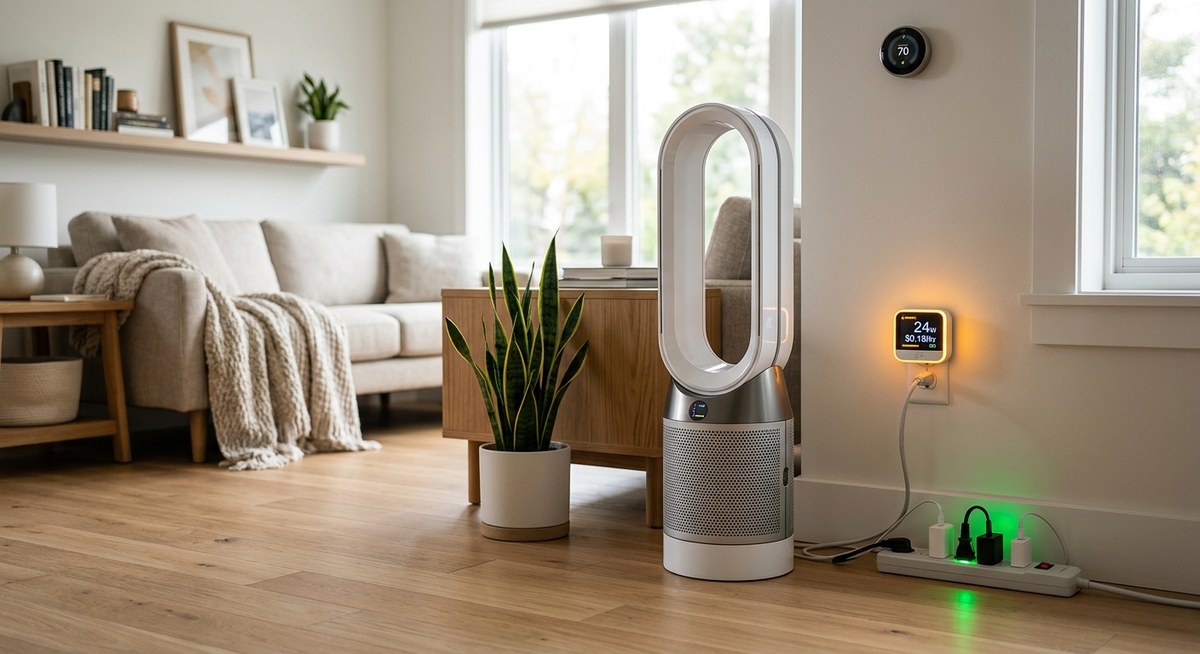
If you bought an air purifier to breathe easier at home, you are probably loving the fresher air. But when that monthly electric bill arrives, a little worry can creep in. Is that quiet hum in the corner secretly draining your wallet? You are not alone. Many homeowners and renters across the United States are asking the same question. The good news is that most modern air purifiers are surprisingly efficient. The bad news is that a few common habits can turn a modest device into an energy hog. Let’s sort out the facts so you can keep your indoor air clean without sending your energy costs through the roof.
Running an air purifier 24/7 on a low fan setting typically costs between $5 and $15 per month, depending on your local electricity rate and the unit’s wattage. The biggest factors are fan speed, filter cleanliness, and room size. By choosing an energy-efficient model, running it on auto mode, and maintaining the filter every 3 to 6 months, you can enjoy cleaner air without a noticeable spike in your monthly bill.
Understanding Your Air Purifier’s Energy Appetite
Most people assume any appliance that runs all day will wreck their budget. But air purifiers are not like space heaters or old window AC units. A typical air purifier uses about 30 to 80 watts on a low fan setting. To put that in perspective, a modern LED TV uses around 100 watts. A laptop charger pulls about 60 watts. So your air purifier is probably using less electricity than the television you watch every night.
The real cost depends on three things: the wattage of your specific model, the fan speed you choose, and how many hours per day you run it. A unit with a higher Clean Air Delivery Rate (CADR) will often use more power when running at max speed. But running it on auto mode, where the fan adjusts based on air quality, usually keeps consumption low.
Expert advice: Check the back of your air purifier for the wattage label. Multiply that number by the hours you run it per day, then multiply by your local electricity rate (cents per kWh). That simple math gives you your daily cost. Most units cost pennies per day.
How Much Does It Really Cost to Run an Air Purifier?
Let’s look at real numbers. The average residential electricity rate in the United States in 2026 is about 16 cents per kilowatt-hour. Here is what a typical air purifier costs to run continuously for a month:
| Fan Speed | Wattage | Hours Per Day | Daily Cost | Monthly Cost |
|---|---|---|---|---|
| Low (sleep mode) | 30 W | 24 | $0.12 | $3.60 |
| Medium | 55 W | 24 | $0.21 | $6.30 |
| High (turbo) | 80 W | 24 | $0.31 | $9.30 |
| Auto (average) | 40 W | 24 | $0.15 | $4.50 |
These numbers assume you run the unit all day and all night. If you only run it while you are home or while you sleep, the cost drops even further. For most households, running an air purifier continuously costs less than a single takeout meal each month.
Factors That Drive Your Air Purifier Electricity Bill Up
Not all air purifiers are created equal. Some models are built to sip power. Others are energy hogs disguised as clean air machines. Here are the main factors that influence how much your unit will cost you:
- Fan speed settings: Running on high 24/7 can double or triple energy use compared to low or auto mode.
- Filter condition: A dirty filter forces the fan to work harder to push air through. This increases wattage and shortens the life of the motor.
- Room size mismatch: Using a small unit in a large room makes it run on high constantly. A properly sized unit for the square footage runs more efficiently.
- Air quality in your area: If you live in a region with frequent wildfire smoke or high pollen counts, the purifier will run at higher speeds more often.
- Energy Star certification: Units with this rating use 30 to 40 percent less energy than non-certified models.
If you want to avoid surprises, look for the Energy Star label when shopping. It is the easiest way to know you are getting an efficient machine.
How to Calculate Your Air Purifier Electricity Cost
You do not need to be a math whiz to figure out what your air purifier is costing you. Just follow these steps:
- Find the wattage. Look on the back or bottom of your unit. It will say something like “Input: 45W” or “Power: 60W.”
- Estimate daily run time. Be honest. Do you run it 8 hours at night, or 24 hours continuously?
- Multiply wattage by hours. This gives you watt-hours per day. For example, 50W x 12 hours = 600 watt-hours.
- Convert to kilowatt-hours. Divide by 1,000. So 600 watt-hours is 0.6 kWh.
- Multiply by your electric rate. If you pay 16 cents per kWh, that is 0.6 x 0.16 = $0.096 per day. About 10 cents.
- Multiply by 30. That gives you the monthly cost. In this case, roughly $2.88 per month.
That is the formula. It takes about two minutes and gives you total clarity. No more guessing.
Simple Strategies to Lower Air Purifier Energy Use
You do not have to choose between clean air and a reasonable electric bill. These strategies let you have both:
- Run it on auto mode. Most modern purifiers have sensors that detect air quality. The fan speeds up only when needed and slows down when the air is clean. This is the most efficient way to operate.
- Close doors and windows. If you are running the purifier in a specific room, keep the door shut. This prevents untreated air from flowing in and keeps the unit from working overtime.
- Clean or replace filters on schedule. A clogged filter is the number one reason air purifiers consume more power. Check your manual for the recommended interval, usually every 3 to 6 months.
- Size the unit correctly. A unit designed for a 300-square-foot room will run inefficiently in a 600-square-foot space. Make sure your purifier matches the room size.
- Use a timer for certain rooms. If you only need clean air while sleeping, set the purifier to run for 8 hours and turn off during the day.
- Consider a smart plug. Some older units do not have timers. A smart plug can schedule on and off times for you.
If you are still unsure about which model fits your home, check out this guide on how to calculate the right air purifier size for every room in your home. Getting the size right is the single best way to keep energy use low.
Common Mistakes That Inflate Your Energy Costs
Even well-meaning owners accidentally drive up their bills. Here are the most common pitfalls and how to avoid them:
| Mistake | Why It Costs You | The Fix |
|---|---|---|
| Running on high 24/7 | Max speed uses 2 to 3 times more power than low speed | Use auto mode or low speed for continuous operation |
| Ignoring filter changes | Dirty filters increase resistance, making the fan work harder | Replace filters every 3 to 6 months |
| Blocking airflow | Placing the unit against a wall or under furniture restricts intake | Keep at least 12 inches of clearance on all sides |
| Oversizing or undersizing | Wrong size forces the unit to run inefficiently | Match the CADR to your room’s square footage |
| Leaving windows open | New pollutants enter constantly, so the unit never reaches clean air | Close windows while the purifier is running |
If you want to learn more about avoiding common slip-ups, read about 5 surprising mistakes that ruin your air purifier’s performance (and how to fix them). Small changes make a big difference.
Choosing an Energy-Efficient Air Purifier for 2026
If you are shopping for a new air purifier this year, energy efficiency should be high on your list. Here is what to look for:
- Energy Star certified. This is the gold standard for efficiency. It guarantees the unit uses less power than the federal minimum.
- Low wattage on the spec sheet. Compare units by looking at their wattage on low and medium settings. Lower is better.
- Auto mode with a real-time PM sensor. Units that adjust fan speed based on actual air quality save the most energy.
- High CADR per watt. This ratio tells you how much clean air you get for each watt of power. Higher numbers mean better efficiency.
- DC motor instead of AC motor. DC motors are significantly more efficient and quieter than traditional AC motors.
For a full overview of features that matter, take a look at this article about 7 key features to look for in an air purifier in 2026. It covers everything from motor type to filter lifespan.
Taking Control of Your Indoor Air and Your Budget
Your air purifier does not have to be a source of stress every time you open your utility bill. With a few simple adjustments, you can enjoy the health benefits of cleaner air without the financial sting. Run it on auto mode. Change the filter on time. Make sure it is sized correctly for the room. And if you are in the market for a new unit, choose one with Energy Star certification and a DC motor.
The bottom line is simple: an air purifier is one of the cheapest appliances in your home to run. The average monthly cost is less than a streaming subscription. So breathe easy, keep the air clean, and stop worrying about the meter spinning. Your lungs will thank you, and your wallet will hardly notice.