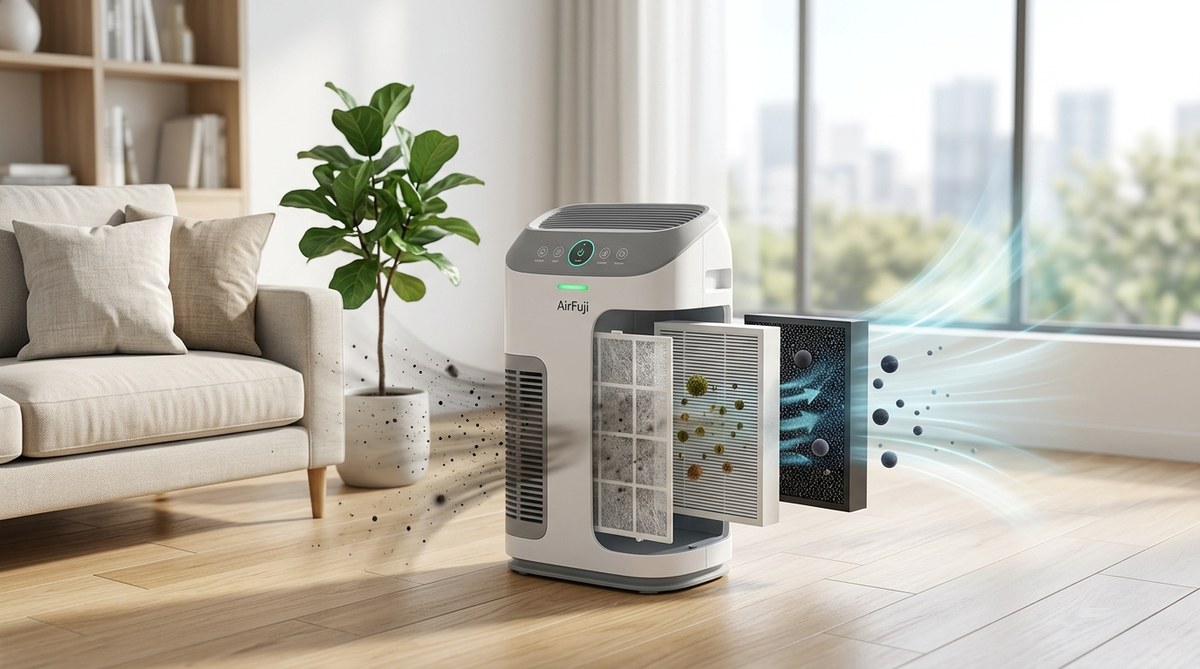
If you have seasonal allergies, a new pet, or live in an area where wildfire smoke drifts through the neighborhood, you have probably asked yourself: what do air purifiers remove? The short answer is that a quality air purifier can capture a wide range of airborne particles and gases. But not every purifier handles every pollutant the same way. Some are fantastic at catching dust and pollen but do little for odors. Others target chemical vapors but let fine particles slip through. Understanding what these machines actually remove will help you pick the right one for your home and stop wasting money on features you do not need.
Air purifiers remove a wide variety of indoor pollutants, but no single unit captures everything. HEPA filters trap 99.97% of particles down to 0.3 microns, including dust, pollen, mold spores, and pet dander. Activated carbon filters absorb gases, smoke, and volatile organic compounds (VOCs). Some units add UV-C light or ionizers for extra microbial control. To get the best results, match the filter type to your specific indoor air concerns.
The Three Main Types of Pollutants Air Purifiers Tackle
Indoor air is a crowded place. The EPA has found that indoor pollutant levels can be two to five times higher than outdoor levels, sometimes much more. That statistic surprises most people. You can break down what an air purifier removes into three broad categories: particulate matter, biological contaminants, and gaseous pollutants.
Particulate matter includes solid and liquid droplets suspended in the air. Think dust, smoke, and fine particles from cooking or burning candles.
Biological contaminants are living or once-living things like mold spores, bacteria, pollen, and pet dander.
Gaseous pollutants include chemical vapors, volatile organic compounds (VOCs) from paints and cleaning products, and odors from cooking or pets.
Each category requires a different approach to filtration. A unit with only a basic pre-filter will not touch VOCs. A carbon-only filter will let pollen pass right through.
How the Filtration Process Works Step by Step
When you turn on an air purifier, it does not magically suck up everything at once. The process follows a clear sequence. Here is what happens inside the machine:
- Air intake. A fan pulls room air into the unit through an intake vent. The fan speed determines how many times per hour the air in the room cycles through the filter.
- Pre-filter capture. Larger particles like dust bunnies, pet hair, and lint hit a coarse pre-filter. This stage extends the life of the finer filters behind it.
- HEPA filtration. The air then passes through a true HEPA filter. This tightly woven mat of fibers traps 99.97% of particles that are 0.3 microns in diameter. That includes most allergens and fine dust.
- Carbon or gas phase filtration. Air moves through a bed of activated carbon or other adsorbent media. This step grabs odors, smoke, and chemical vapors.
- Optional treatment. Some units use UV-C light to damage the DNA of bacteria and viruses, or an ionizer to charge remaining particles so they stick to collection plates.
- Clean air exhaust. The fan pushes the filtered air back into the room, usually through a vent at the top or front.
That sequence happens continuously. Over the course of an hour, a properly sized unit will cycle the entire room’s volume through those six stages multiple times.
A Closer Look at What Each Filter Type Captures
Not all filters are created equal. Knowing the difference helps you avoid buying a unit that looks good on paper but fails to address your actual problems. Here is a breakdown of the most common filter technologies and what they actually remove.
HEPA Filters
True HEPA is the gold standard for particle removal. It catches dust mites, pollen, mold spores, pet dander, smoke particles, and many bacteria. The fibers are arranged in a random, matted pattern that intercepts particles through three mechanisms: interception, impaction, and diffusion. Even particles smaller than 0.3 microns get trapped because Brownian motion causes them to bounce into the fibers.
Activated Carbon Filters
Carbon filters use a process called adsorption. Pollutants stick to the huge internal surface area of the carbon granules. A single gram of activated carbon can have a surface area of over 3,000 square feet. These filters remove gases, odors, smoke, cooking smells, and VOCs from paint, furniture, and cleaning products. They do not capture particulate matter well on their own.
UV-C Light
Ultraviolet light in the C band can damage the genetic material of microorganisms. It is effective against bacteria, viruses, and mold spores that pass close to the bulb. However, UV-C does not remove particles. It only neutralizes living organisms. And the exposure time needs to be long enough to work, which is not always the case in portable units.
Ionizers and Electrostatic Precipitators
These devices charge particles so they stick to collection plates or nearby surfaces. They can capture very fine particles, but they produce a small amount of ozone as a byproduct. Some people prefer to avoid ozone entirely, especially those with respiratory conditions.
| Filter Type | What It Removes | What It Misses |
|---|---|---|
| True HEPA | Dust, pollen, mold spores, pet dander, smoke particles, bacteria | Gases, odors, VOCs, chemical vapors |
| Activated Carbon | Smoke, cooking odors, VOCs, chemical fumes, some gases | Particles like dust and pollen (very poorly) |
| UV-C Light | Bacteria, viruses, mold spores (when exposed long enough) | Particles, gases, odors, smoke |
| Ionizer | Ultra-fine particles (sticks them to surfaces) | Gases, VOCs; may produce trace ozone |
| Pre-filter | Large debris: pet hair, lint, dust bunnies | Fine particles, gases, microbes |
What Air Purifiers Cannot Remove
It is just as important to know the limits. Even the best air purifier will not solve every indoor air problem. Here are a few things they typically cannot handle:
- Large settled dust. If dust has already landed on your shelves and floors, an air purifier will not pick it up. You need a vacuum or a damp cloth for that.
- Mold growing on surfaces. An air purifier can capture mold spores floating in the air, but it will not kill mold that is actively growing on your bathroom ceiling or behind the drywall. You have to address the moisture source and clean the mold directly.
- Radon gas. This radioactive gas seeps up from the ground through basements and foundations. Standard carbon filters do not adsorb radon effectively. You need a radon mitigation system, not an air purifier.
- Carbon monoxide. This odorless, colorless gas from gas appliances and car exhaust requires a dedicated CO detector and proper ventilation. Activated carbon filters are not designed to capture carbon monoxide.
- Humidity. Air purifiers do not remove moisture from the air. If your home feels damp, you need a dehumidifier. Some units combine both functions, but standalone purifiers do not change humidity levels.
“The single biggest mistake people make is buying an air purifier before they understand what is actually in their indoor air. A unit that works wonders for a home with cats will do very little for a home with a fresh paint odor problem. Test your air or at least pay attention to your specific symptoms before you choose a filter.” — Dr. Aida Torres, indoor air quality researcher
Matching the Filter to Your Specific Problem
The best way to answer “what do air purifiers remove” is to flip the question: what do you need removed from your air? Here is how to match your situation to the right filter combination.
If you have seasonal allergies: You are dealing with pollen, mold spores, and dust mites. A true HEPA filter is your best friend. Carbon is optional unless you also want odor control.
If you have pets: Pet dander is a particle, so HEPA handles it. But pet odors, especially from cats and dogs, require a generous amount of activated carbon. Look for a unit with at least two to three pounds of carbon media.
If you live near wildfire zones: Smoke contains both fine particles and irritating gases. You need a strong HEPA filter plus a thick carbon layer. Many 2026 models now feature specialized wildfire smoke modes that ramp up fan speed and prioritize carbon filtration.
If you are sensitive to chemicals and VOCs: New furniture, paint, carpet, and cleaning products release a steady stream of gases. Activated carbon is your primary tool. The more carbon, the better. Look for units with a separate carbon pre-filter or a combined HEPA-carbon hybrid.
If you have asthma: Triggers include dust mites, mold, pet dander, and smoke. A HEPA filter addresses the particles, and a carbon layer helps with any chemical irritants. Many people also pair their purifier with a dehumidifier to keep humidity below 50 percent, which discourages dust mites and mold growth.
Common Mistakes That Reduce Effectiveness
Even a great air purifier can underperform if you use it the wrong way. Avoid these pitfalls:
- Putting the unit in a corner. Air needs to flow freely around the intake. Leave at least one to two feet of clearance on all sides.
- Choosing the wrong size. A unit rated for 200 square feet will struggle in a 500 square foot living room. Check the Clean Air Delivery Rate (CADR) and match it to your room size.
- Skipping filter changes. A clogged HEPA filter cannot pass air. The motor works harder and less air gets cleaned. Replace filters on schedule, usually every six to twelve months depending on usage.
- Running it only sometimes. Air purifiers work best when they run continuously. Turning it off during the day lets pollutants build back up.
- Relying on ionizers alone. Ionizers can help, but they do not actually remove particles from the air. Those charged particles often settle on walls, furniture, and floors, where they can get stirred up again.
How to Pick the Right Air Purifier for Your Home in 2026
The market has grown significantly over the past few years. In 2026, you will find options with smart sensors that adjust fan speed automatically, Wi-Fi enabled units that sync with your phone, and models that report real-time air quality readings. But the fundamentals remain the same.
Start by measuring your room. Calculate the square footage and look for a unit with a CADR rating that matches or exceeds that number. For particles, a CADR of at least 200 is good for a medium sized bedroom.
Next, identify your primary pollutant. If you are not sure, consider buying an indoor air quality monitor first. These devices measure PM2.5, VOCs, humidity, and temperature. Run it for a week and see what spikes. That will tell you exactly what you need to filter.
If you want a deeper look at the technical side, check out our guide to HEPA versus UV-C air purifiers and which one actually cleans your air. It breaks down the strengths and weaknesses of each technology.
For those with specific health concerns, our article on choosing an air purifier for asthma and allergy relief walks through the key features that matter most for respiratory health.
The Bottom Line on What a Good Purifier Can Do
Let us quickly recap the main pollutants that a well equipped air purifier can remove:
- Dust and dust mites
- Pollen from trees, grass, and weeds
- Pet dander and pet hair
- Mold spores and mildew particles
- Tobacco and wildfire smoke
- Cooking odors and grease particles
- Volatile organic compounds from paints, cleaners, and furniture
- Bacteria and some viruses (with UV-C or high grade HEPA)
- Fine particulate matter (PM2.5 and PM10)
It cannot remove radon, carbon monoxide, humidity, or mold growing on surfaces. It will not clean dust that has already settled. And it will not work well if you buy the wrong size or forget to change the filters.
Making Your Air Purifier Work Harder for You
You have control over more than just the machine itself. A few simple habits can boost the effectiveness of any air purifier you own.
Keep windows and doors closed on high pollen days and during wildfire events. Run your purifier on a higher fan speed when you cook, clean, or vacuum, because those activities kick up particles. Vacuum with a HEPA equipped vacuum to avoid recirculating dust. And change your HVAC filter regularly to support your whole home system.
If you live in a humid climate, pair your purifier with a dehumidifier. Dust mites and mold thrive above 60 percent relative humidity. Bringing humidity down to 40 to 50 percent makes the purifier’s job much easier. Our guide on maintaining your dehumidifier for long lasting indoor comfort can help you keep both devices running smoothly together.
The Simple Pleasure of Breathing Cleaner Air
At the end of the day, knowing what do air purifiers remove is the first step toward making a smart purchase. The right unit, matched to your specific indoor air problems, can reduce allergy symptoms, cut down on dusting, and make your home feel fresher. It is not a magic wand that solves everything, but it is one of the most effective tools you can buy for your health.
Start small. Identify your biggest complaint. Is it morning congestion? Lingering cooking smells? A dusty room that never seems clean? Pick the filter that targets that problem, size it properly, and run it consistently. Your lungs will thank you.