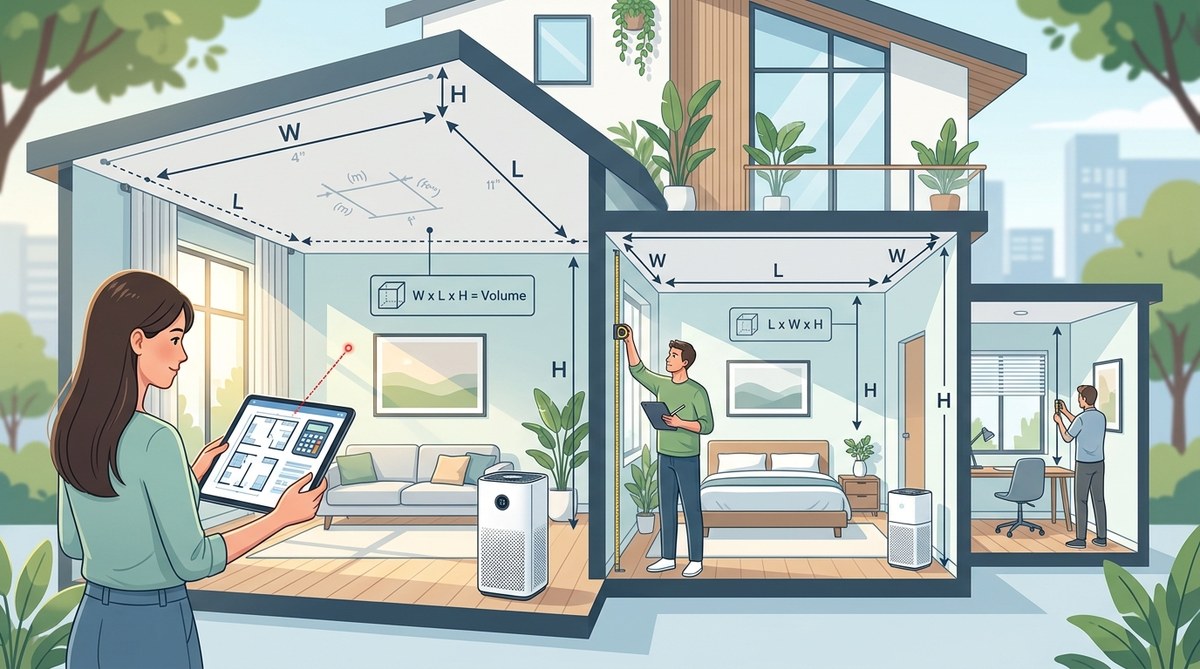
Using an air purifier size calculator ensures you don’t buy a unit that’s too weak or oversized for your room. Focus on square footage, CADR rating, and ceiling height. For most homes, aim for a CADR of at least two thirds of your room’s area. This guide gives you the exact numbers to match every space.
Why Room Size Matters More Than You Think
An undersized air purifier struggles to clean the air. An oversized one wastes energy and can create uncomfortable drafts. The sweet spot lies in matching the purifier’s capacity to your room’s volume. That’s where an air purifier size calculator comes in. It takes the guesswork out of shopping and helps you breathe easier.
Since 2026 models are now available with smarter sensors and higher CADR ratings, it’s even more important to get the math right. A few simple calculations will save you time, money, and frustration.
Measure Your Room the Right Way
Start with a tape measure. You need the length and width in feet. Multiply them to get the square footage. For example, a 12‑foot by 15‑foot bedroom equals 180 square feet.
But here’s the part most people miss: ceiling height. Standard rooms have 8‑foot ceilings. If your living room has a vaulted ceiling or a loft, you need to adjust. Multiply the square footage by the ceiling height in feet, then divide by 8. This gives you an adjusted square footage that reflects the true air volume.
Example: A 200 sq ft room with a 10‑foot ceiling becomes 200 × 10 ÷ 8 = 250 adjusted sq ft. Use this number when choosing your purifier.
What CADR Means and How to Use It
CADR stands for Clean Air Delivery Rate. It tells you how quickly a purifier can remove smoke, dust, and pollen from a room. The number is measured in cubic feet per minute. For smoke removal, the CADR should be at least two thirds of your room’s square footage.
Rule of thumb: If your room is 300 sq ft, look for a CADR of 200 or higher for smoke. For dust and pollen, you can often use a slightly lower number, but smoking, cooking, and pet dander call for higher performance.
Most manufacturers list a suggested room size on the box, but they often assume a standard 8‑foot ceiling. If your ceiling is higher, use the adjusted square footage we calculated above. That’s where the air purifier size calculator becomes your best friend.
Step-by-Step Process to Find Your Perfect Fit
- Measure the room – Length × width = square footage.
- Check ceiling height – If it’s over 8 feet, calculate adjusted square footage.
- Determine your main concern – Smoke, dust, pollen, or a general mix.
- Look up CADR ratings – For the primary pollutant, aim for CADR ≥ (adjusted sq ft × 0.67).
- Cross‑reference with room size – Many good purifiers advertise a maximum room size. Use it as a starting point, but rely on CADR for accuracy.
- Account for open floor plans – If the room is open to a hallway or kitchen, treat the whole connected space as one room.
- Consider multiple units – In very large or oddly shaped rooms, one unit may not be enough. Two smaller units often work better than one oversized model.
Common Mistakes People Make
- Ignoring ceiling height – A room with a 12‑foot vaulted ceiling needs about 50% more CADR.
- Buying based on filter type alone – HEPA is great, but without enough CADR, the air won’t cycle enough times per hour.
- Forgetting doors and windows – If you leave a door open, the purifier has to cover more area.
- Placing the unit in a corner – Airflow gets blocked. Put it at least 18 inches from walls.
- Skipping the calculator – Guessing leads to returns or wasted money.
Use our guide on common air purifier mistakes to avoid these pitfalls.
Quick Reference Table for Room Sizes
| Room Type (8 ft ceiling) | Square Footage | Recommended CADR (Smoke) | Typical Unit Size |
|---|---|---|---|
| Small bedroom | 100 – 150 sq ft | 70 – 100 | Compact / desktop |
| Master bedroom | 200 – 300 sq ft | 140 – 200 | Medium / mid‑tier |
| Living room / family room | 300 – 500 sq ft | 200 – 335 | Large / whole‑room |
| Open kitchen & living | 500 – 800 sq ft | 335 – 536 | Extra‑large / two units |
| Basement / home gym | 400 – 600 sq ft | 268 – 402 | Large / high‑CADR |
For rooms with higher ceilings, multiply the square footage by (ceiling height / 8) and then use the same CADR guideline.
When to Use a More Powerful Unit
Some situations demand a higher CADR than the basic formula suggests:
- Allergy season – If you or family members suffer from hay fever, go 20‑30% above the minimum CADR.
- Smoking or cooking odors – A higher smoke CADR keeps the room fresh.
- Pet dander – Cats and dogs produce fine particles that need more filtration passes.
- Wildfire smoke – In 2026, many regions still face heavy smoke days. A high‑CADR purifier with a carbon pre‑filter helps.
For more tailored recommendations, check out our guide to choosing the right air purifier for allergies.
Expert Advice: “When in doubt, size up. A slightly larger unit running on low is quieter and more efficient than a small unit running on high all the time. The energy savings and noise reduction are worth the extra upfront cost.” – Emily Chen, Indoor Air Quality Specialist
Factors That Change Your Calculation
Besides ceiling height, a few other elements affect the right size:
- Room shape – Long, narrow rooms need units with good throw distance.
- Furniture layout – Sofas and bookshelves can block airflow.
- Number of occupants – More people means more dust, skin flakes, and CO₂.
- Pets – Dogs and cats produce dander and odors.
- HVAC system – If your home has a central air filter, the purifier can be smaller.
- Air purifier placement – A unit in the center of the room works better than one hidden behind a curtain.
All these variables make a simple air purifier size calculator even more valuable. It helps you account for the unique conditions of each room.
How to Use an Online Air Purifier Size Calculator
Many websites, including ours at Air Fuji, offer free online calculators. They ask for:
- Room dimensions (length, width, height)
- Primary concern (smoke, dust, pollen, or general)
- Ceiling type (vaulted, standard, or cathedral)
- Number of windows and doors (optional)
The calculator then returns a recommended CADR range and suggests specific models that meet that range. It’s a huge time‑saver.
If you want to go deeper, our 7 key features to look for in an air purifier in 2026 article explains sensor quality, noise levels, and filter replacement costs.
What About Open Floor Plans?
Open floor plans are common in 2026 homes. A kitchen, dining area, and living room often flow together. Measure the entire open space as one big room. Then divide the total square footage by the number of purifiers you plan to use.
For example, a 600 sq ft open plan might need two units, each covering 300 sq ft, or one very large unit that handles 600 sq ft. The calculator will tell you which is better based on CADR.
Placing one unit in the center of the open area can work, but two units on opposite sides often provide better air circulation.
Don’t Forget Filter Replacement
A perfectly sized purifier won’t help if the filter is clogged. Check the manufacturer’s recommended replacement schedule. Most HEPA filters last 6‑12 months, and carbon pre‑filters may need swapping every 3‑6 months.
To keep your air clean year‑round, learn more about how to maximize air purifier effectiveness.
Make Every Breath Count with the Right Fit
Buying an air purifier is an investment in your health. Taking the time to run an air purifier size calculator for each room ensures you get the right machine for your home. No more guessing, no more wasted money.
Start by measuring your living room. Then check the CADR on that model you’ve been eyeing. If it matches the numbers in this guide, you’re good to go. If not, adjust your choice until everything lines up.
Your lungs will thank you, and so will your wallet. Breathe better today by making a simple calculation that works every time.