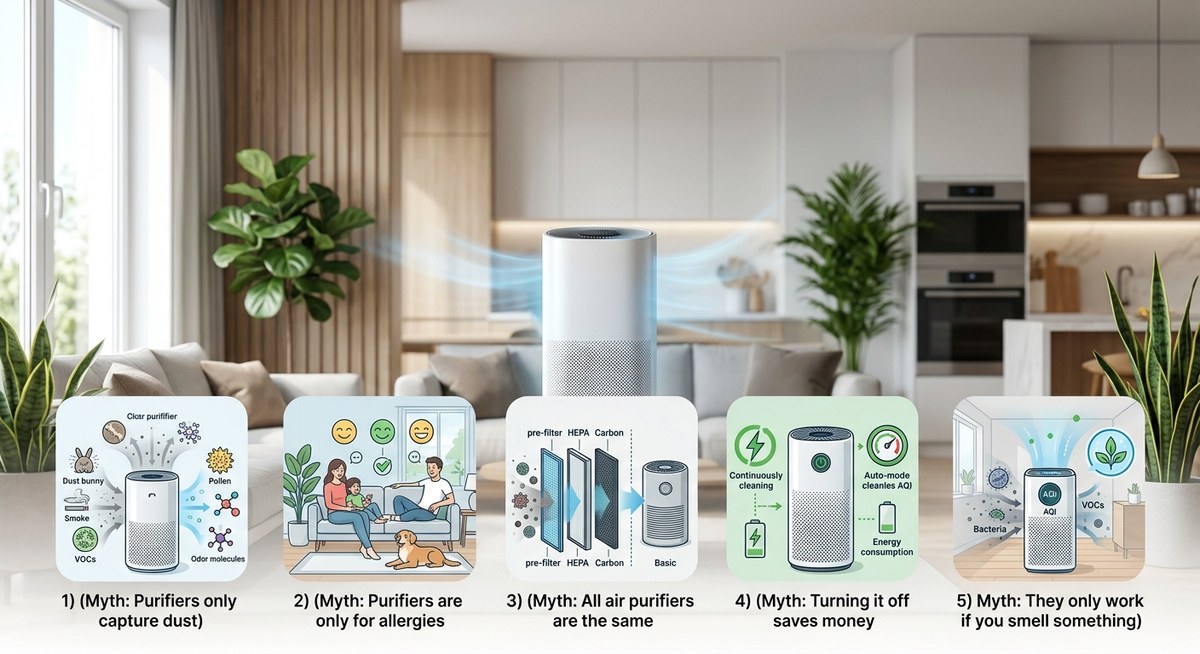
Think you know everything about air purifiers? You are not alone. Many homeowners and renters across the United States buy these machines hoping for cleaner air, only to fall for false claims that waste money and sometimes even harm indoor air quality. One neighbor swears a tiny desktop unit cleans the whole living room. Another insists they never need to change the filter. And plenty of people worry that running an air purifier will make their electricity bill skyrocket. With so much conflicting advice, it is easy to get confused. But some of these beliefs are not just harmless myths. They can actually make your home less healthy. Let us clear the air with facts you can trust.
Air purifier myths cause many people to overspend, underperform, or even risk their health. The truth is simple: HEPA filters are the gold standard, ozone generators are dangerous, bigger units do not always mean better results, and filters must be replaced on schedule. Choosing the right machine for your room size and running it continuously delivers real benefits. Stop guessing. Use proven facts to protect your family.
The HEPA Hype and the Allergy Cure Myth
One of the most persistent air purifier myths says that buying a HEPA purifier completely removes all allergens and cures allergies. That sounds amazing, but it is only half true.
HEPA (High-Efficiency Particulate Air) filters capture 99.97% of particles as small as 0.3 microns. They trap pollen, dust mites, pet dander, and mold spores. But here is the catch: they cannot remove settled dust from your furniture or kill mold growing inside walls. An air purifier works in the air, not on surfaces. If you have severe allergies, running a HEPA purifier in your bedroom will help you sleep better, but you still need to vacuum, dust, and control humidity.
“Think of an air purifier as a teammate, not a miracle worker. Pair it with regular cleaning and humidity control for the best allergy relief.” – Laura Chen, Certified Indoor Air Quality Specialist
To get real relief, use a true HEPA filter, not a “HEPA-type” or “HEPA-like” knockoff. Check the label. True HEPA is tested and certified.
The Bigger Is Always Better Fallacy
You see a massive air purifier on sale at a warehouse store and think, “This must clean my whole house.” Wrong. Oversizing an air purifier for a small room wastes electricity and creates noisy airflow. Undersizing leaves pollutants floating around.
The correct measure is CADR (Clean Air Delivery Rate). CADR tells you how many cubic feet of air per minute the machine cleans for specific pollutants like smoke, dust, and pollen. A unit with a CADR of 200 for smoke works well in a room of about 300 square feet. In a 150-square-foot bedroom, that same machine will clean the air too fast and cycle on and off more often, wasting energy.
| Myth | Fact |
|---|---|
| A bigger purifier always cleans better. | Match the CADR to your room size for efficiency. |
| You can clean multiple rooms with one unit. | Air purifiers work best in closed, single rooms. |
| All HEPA filters are identical. | True HEPA passes strict certification; imitations do not. |
| Ozone generators are safe for air cleaning. | Ozone irritates lungs; avoid them unless zero ozone is certified. |
| Filters last forever if you vacuum them. | Most HEPA filters are disposable and must be replaced per the manual. |
The Filter Fiasco: Washable and Forever Filters
Another common air purifier myth claims you can wash a HEPA filter and reuse it forever. This is dangerous advice. While some pre-filters are washable (woven mesh that catches large particles), the actual HEPA media is a fine mat of fibers. Water damages the fibers, reduces efficiency, and can cause mold growth inside the filter. Always read the manufacturer’s instructions. Some expensive units have permanent, washable electrostatic filters, but those are not true HEPA. They catch less.
If you own a unit with a true HEPA filter, plan to replace it every 6 to 12 months depending on usage and air quality. Running a clogged filter strains the motor and pushes dirty air back into the room.
Here are 3 steps to verify any air purifier’s claims before you buy:
- Look for the CADR certification from the Association of Home Appliance Manufacturers (AHAM). This is the industry standard.
- Check the type of filter: true HEPA, not “HEPA-like” or “electrostatic.” If it says “ionizer” or “ozone generator,” be wary.
- Confirm the filter replacement cost. Some units have cheap machines but expensive filters that need changing every three months. Calculate the annual cost.
The Ozone Deception
In the 1990s, many Americans bought “air purifiers” that produced ozone intentionally. Manufacturers claimed ozone destroyed pollutants. Science proved them wrong. Ozone is a lung irritant. It can worsen asthma, cause coughing, and even damage healthy tissue. The California Air Resources Board and the EPA have warned against ozone generators for years. Yet some units still sell with “ionizer” or “plasma” features that produce trace amounts of ozone. In 2026, legitimate air purifiers should be CARB certified for zero ozone.
If you see a machine marketed as “ozone-free,” verify it. If it uses UV-C light, that is generally safe because the light is contained inside the unit and does not release ozone into the room. But some UV units can produce ozone if not designed properly. Stick with mechanical filtration (HEPA) or a combination of HEPA and carbon.
The Noise Nightmare That Is Not True
Many people avoid air purifiers because they think all of them are loud enough to disturb sleep. That used to be true for older models, but modern machines have improved dramatically. In 2026, many units run on “sleep mode” at under 25 decibels, which is quieter than a whisper. The key is to look at the decibel rating at low speed.
Here is a bulleted list of signs that you might actually need an air purifier:
- You or your family members wake up stuffy or with a scratchy throat.
- You notice visible dust settling on surfaces within a day.
- Someone in the home has seasonal allergies or asthma.
- You own pets that shed fur and dander.
- Your home is near a highway, construction site, or wildfire-prone area.
If you are shopping for a bedroom unit, prioritize models with a noise rating below 30 dB on the lowest setting. And place the purifier at least 3 feet away from the bed for proper airflow.
The Energy Bill Bogeyman
Some people run their air purifier for a few hours and then turn it off to save electricity. That is a mistake. Air purifiers are most effective when they run continuously. Modern units with Energy Star certification consume about the same power as a 40-watt light bulb. Running it 24/7 costs roughly $30 to $50 per year depending on your local electricity rates. That is less than a fast-food dinner for two. Leaving it off for eight hours allows pollutants to build back up, and then the machine has to play catch-up.
To maximize effectiveness without worrying about cost, set the purifier to auto mode. Many models use sensors to adjust fan speed based on real-time air quality.
If you want to understand more about how to pick the right machine, read our article on how to calculate the right air purifier size for every room in your home. It walks you through measuring square footage and matching CADR.
The One-Time Purchase Myth
A lot of people buy an air purifier thinking it is a one-time expense. Then they are shocked when they have to buy replacement filters every year. That is not a myth, it is reality. But some manufacturers try to trick you with “permanent” filters that claim to last the lifetime of the unit. Those are almost always electrostatic or washable media, which do not trap particles as effectively as true HEPA. They also lose efficiency over time.
Set a calendar reminder every 6 months to check your filter. Most units have a filter change indicator light. Do not ignore it. A dirty filter is worse than no filter because it becomes a breeding ground for bacteria.
For more help, our guide on why your air purifier isn’t working as well as it should covers common filter mistakes and placement errors.
The Placement Pitfall
Even the best air purifier does nothing if you hide it behind a sofa or stuffed into a corner. Air needs to flow freely into the intake and out of the exhaust. Place the unit in the center of the room or at least a foot away from walls and furniture. Also, avoid putting it near electronics that generate heat, because that can confuse the sensor.
Bedroom placement tip: position the purifier near the head of the bed, but not directly beside your pillow. Let it draw in the air you are breathing.
Breathe Smarter, Not Harder: Your Myth-Free Air Quality Plan
Now you know the facts. The biggest air purifier myths are easy to bust if you rely on certified data and common sense. Stop trusting marketing claims that promise miracles. Instead, choose a true HEPA filter with a verified CADR, replace the filter on schedule, run the machine 24/7 in the room you use most, and keep the unit in open space. Pair that with regular vacuuming and dusting, and your indoor air will improve noticeably.
Still have questions? We have plenty of resources. Start with our piece on how to maximize air purifier effectiveness for a healthier home in 2026. Or if allergies are your main concern, check out how to choose an air purifier for asthma and allergy relief.
Take a deep breath. You have got this. The path to cleaner air starts with knowing what is true and what is just hot air.