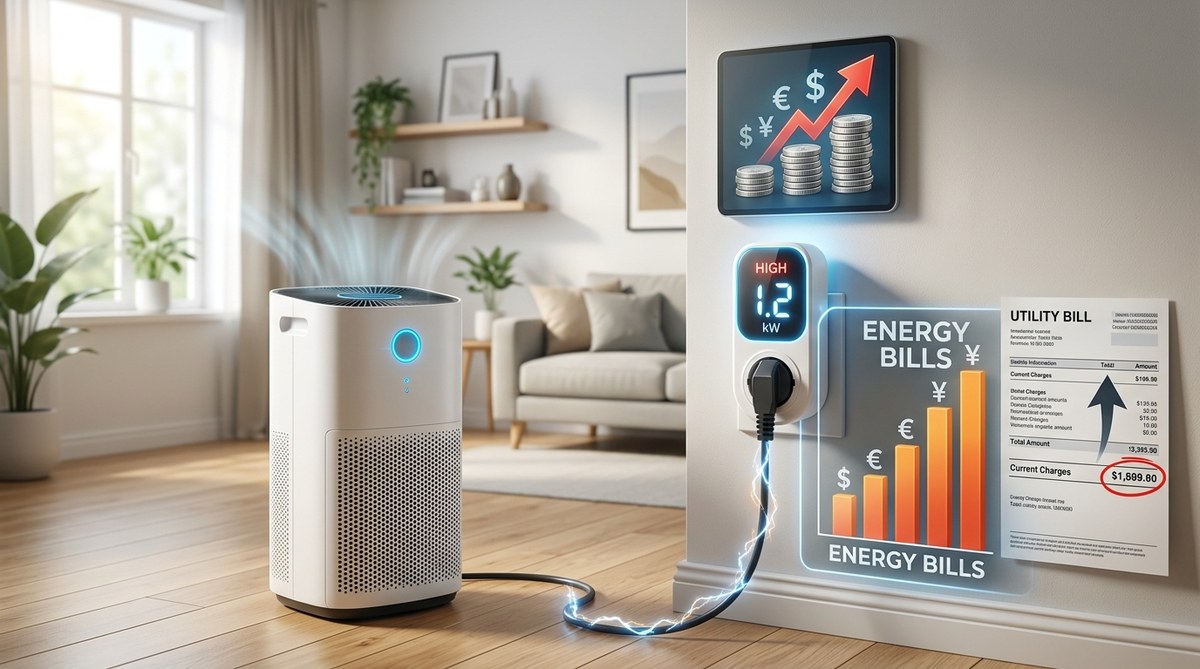
You open your monthly electric bill and feel a small knot in your stomach. The HVAC system, the fridge, that home office setup… it all adds up. And now you are thinking about adding one more appliance: an air purifier. The question that stops many cost-conscious homeowners and renters cold is simple. Do air purifiers increase electric bill costs in a way that hurts your budget? The short answer is yes, they use electricity. But the real story is less about a scary spike and more about understanding a few key numbers. Most modern purifiers cost less to run than a traditional 60-watt light bulb. Let’s break down the real math so you can breathe easier without worrying about your wallet.
A typical energy-efficient air purifier running 24/7 on low speed adds roughly $5 to $10 per year to your electric bill. The real cost comes from running a poorly sized unit on high speed all day. By choosing the right model for your room size and using smart settings, you can enjoy cleaner air without a noticeable change in your monthly utility costs.
How Much Power Does an Air Purifier Actually Use?
To answer the question “do air purifiers increase electric bill costs significantly”, you need to look at wattage. Most household air purifiers draw between 20 and 100 watts on their highest fan setting. On low or sleep mode, that number often drops to between 5 and 15 watts.
Let’s put that in perspective. A typical box fan uses about 80 to 100 watts. A modern laptop charger pulls around 45 to 60 watts. Your refrigerator uses about 150 watts on average. So a purifier sits somewhere between a laptop and a fan in terms of energy appetite.
The table below shows real-world examples for 2026 models and their estimated yearly cost.
| Purifier Type | Typical Wattage (High) | Typical Wattage (Low) | Est. Yearly Cost (24/7 on low) |
|---|---|---|---|
| Small personal unit | 25 watts | 5 watts | $4.50 |
| Mid-sized room purifier | 55 watts | 10 watts | $9.00 |
| Large whole-home unit | 90 watts | 20 watts | $18.00 |
*Costs based on the 2026 U.S. average electricity rate of $0.14 per kWh.
As you can see, the financial impact is small. The real spike in your bill comes from other appliances, not your air purifier.
The Hidden Factors That Drive Up Your Bill
If the base wattage is so low, why do some people report higher bills after buying a purifier? The answer lies in how you use it. Here are the three biggest culprits that turn a low-cost device into a budget strain.
1. Running the Wrong Speed for the Room Size
This is the most common mistake. A small purifier in a large living room has to run on turbo mode constantly to keep up. That 90-watt draw adds up over a month. On the other hand, an oversized purifier on a low setting uses very little power.
2. Forgetting to Clean or Replace Filters
A clogged filter makes the fan work harder. The motor strains to pull air through the dense media. This increases wattage draw by 15 to 30 percent in some cases. A dirty pre-filter is the number one reason a purifier starts eating more electricity.
3. Using Ionizers or UV-C Lights Unnecessarily
Many purifiers come with extra features like ionizers or UV-C sanitizing lights. These addons draw extra power. If you do not need them for specific air quality issues, turning them off saves energy.
“The cheapest kilowatt-hour is the one you never use. Keep your filters clean and run the fan on the lowest setting that still keeps your air quality green. That is the single best way to keep your electric bill low.” Indoor air quality specialist, Dr. Maria Chen
A Simple 3-Step Process to Calculate Your Own Cost
You do not need a degree in electrical engineering to figure out your exact cost. Follow these steps.
- Find the wattage. Look at the back or bottom of your purifier for a label. It will list the wattage. If you only see amps, multiply amps by 120 (U.S. household voltage) to get watts.
- Estimate your daily run time. Most people run their purifier 24 hours a day, but you might only use it at night. Be honest about your usage.
- Do the math. Multiply watts by hours used per day, divide by 1,000 to get kilowatt-hours (kWh), then multiply by your local electric rate (found on your bill).
Example: A 50-watt purifier running 12 hours a day. 50 x 12 = 600 watt-hours per day. That is 0.6 kWh. At $0.14 per kWh, that costs about 8 cents per day, or roughly $2.50 per month.
Energy-Saving Mistakes to Avoid
Many well-meaning owners accidentally increase their costs. Here is a list of common errors and how to fix them.
- Mistake: Placing the purifier in a corner behind furniture.
- Fix: Give it at least 18 inches of clearance on all sides for proper airflow.
- Mistake: Running the purifier on high speed all night in an empty room.
- Fix: Use the auto mode or a timer so it only works when you are in the room.
- Mistake: Buying a unit with a very high CADR rating for a tiny bedroom.
- Fix: Match the CADR to your room size. Oversizing wastes energy.
- Mistake: Ignoring the pre-filter.
- Fix: Vacuum or wash the pre-filter every two weeks to keep the main motor from overworking.
Choosing an Energy-Efficient Air Purifier in 2026
If you are still shopping, look for a few specific features that keep your electric bill low.
- Energy Star certification. This is the easiest shortcut. Certified models are at least 30 percent more efficient than standard models.
- DC motor. Units with DC motors use significantly less power than those with AC motors, especially on lower fan speeds.
- Auto mode with a particle sensor. A purifier that adjusts its speed based on real-time air quality will not waste power running at full blast when the air is clean.
- Low standby power. Some smart purifiers use a small amount of power even when “off.” Look for models with low standby draw.
For more guidance on finding the right fit, check out our guide on how to select the perfect air purifier for your family’s health and safety. And if you already own one, make sure you are not making common mistakes by reading about 5 surprising mistakes that ruin your air purifier’s performance.
The Real Cost of Clean Air
So, do air purifiers increase electric bill costs in a meaningful way? For the vast majority of households, the answer is no. The cost is comparable to leaving a small LED lamp on. The peace of mind and health benefits, especially for allergy sufferers or people living in areas with seasonal smoke, usually outweigh the tiny monthly expense.
The key is being intentional. Choose the right size. Keep the filters clean. Use the lowest effective fan speed. When you do those three things, your air purifier becomes one of the cheapest appliances in your home to operate. You get the benefit of cleaner air without the guilt of a higher utility bill.
Now that you know the real numbers, you can run your purifier with confidence. Breathe deeply. Your budget is safe.