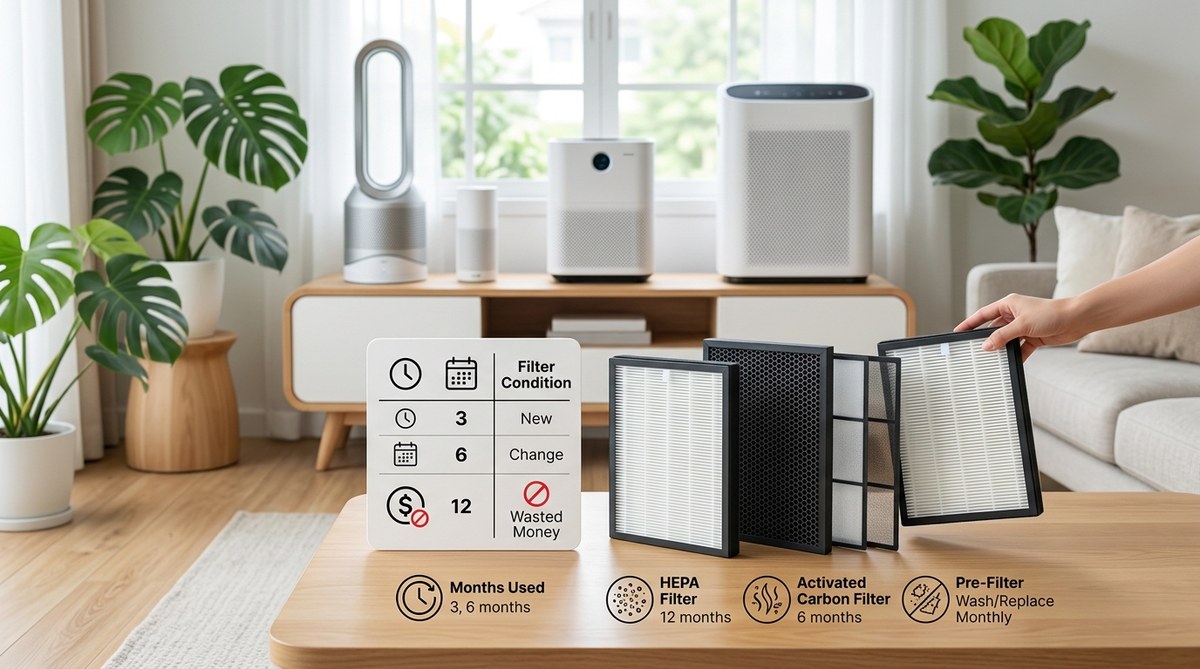
You bought an air purifier to breathe easier, not to create a new monthly bill that feels like a second car payment. But if you are replacing filters too often, you are burning cash. If you wait too long, your machine is just a noisy fan moving dirty air around. The sweet spot is a real, fact-based air purifier filter replacement schedule that matches the type of filter inside your machine. Let’s clear the air and lock in the exact timeline for every common filter type so your wallet and your lungs both win.
True HEPA filters need replacement every 12 to 18 months in average home conditions. Carbon pre-filters should be swapped every 3 to 6 months. Washable pre-filters must be rinsed every 30 days and replaced every 2 to 3 years. Permanent electrostatic filters never need replacement but require monthly cleaning. Ignoring these timelines wastes money or leaves your air dirty.
The Big Mistake That Costs You Real Money
Most people change their air purifier filter based on a flashing light or a sticker on the box. That is a trap. Manufacturer recommendations are designed for worst-case scenarios: chain smokers, heavy construction zones, or homes with five Golden Retrievers. Your home is probably cleaner than that. If you follow the sticker blindly, you could be throwing away a filter that still has months of life left.
The opposite mistake is just as bad. Waiting until the filter looks dark and fuzzy means your purifier has been running at half power for weeks. You paid for clean air and you are not getting it. The right approach uses a simple schedule adjusted for your real life.
The Exact Schedule for Every Filter Type
Not all filters are created equal. Some are disposable, some are washable, and some live forever if you treat them right. Here is the breakdown.
True HEPA Filters
True HEPA is the gold standard for trapping particles like pollen, dust mites, and pet dander. These filters are not washable. Once they clog, you toss them.
- Average home (two people, no pets, moderate dust): Replace every 18 months.
- Home with one pet or a smoker: Replace every 12 months.
- Home with multiple pets, heavy cooking, or wildfire smoke exposure: Replace every 6 to 9 months.
A good rule of thumb is to check the filter every 6 months. If it looks gray or feels heavy, move up your replacement date. If it still looks clean and white, you can stretch it to 18 months.
Carbon (Activated Carbon) Pre-Filters
Carbon filters are designed to trap odors, VOCs, and gases. They are often combined with a thin layer of foam or fabric. These filters work by adsorption, which means they have a finite capacity. Once the carbon is full, it stops working. Worse, it can start releasing trapped odors back into the room.
- Normal conditions: Replace every 3 to 4 months.
- Homes with cooking odors, paint fumes, or smokers: Replace every 2 to 3 months.
- Homes with minimal odor sources: You can stretch to 6 months, but do not go longer.
If your air purifier is in the kitchen or near a litter box, change the carbon pre-filter more often. It is a small cost compared to breathing in lingering smells.
Washable Pre-Filters
Many modern purifiers include a washable pre-filter that catches large particles like hair and lint. This extends the life of the main HEPA filter. These are the easiest to maintain.
- Cleaning schedule: Rinse with water every 30 days. Let it dry completely before putting it back.
- Replacement schedule: Replace the washable pre-filter every 2 to 3 years, or when you notice tears or warping.
A clean pre-filter is the single best way to extend the life of your expensive HEPA filter. If you skip this step, you are forcing your main filter to do double duty.
Permanent (Electrostatic) Filters
Some purifiers use electrostatic or washable HEPA-type filters that never need replacement. They rely on static charge to trap particles.
- Cleaning schedule: Wash every 1 to 3 months, depending on dust levels.
- Replacement schedule: Never. But the filter will lose efficiency over time. Most manufacturers recommend replacing the whole unit after 5 to 8 years.
These filters save you money on replacements but require consistent cleaning. If you let them get too dirty, the static charge collapses and the purifier becomes useless.
How to Adjust the Schedule for Your Home
Your home is unique. A schedule that works for a studio apartment in Phoenix will not work for a farmhouse in Vermont. Here are the factors that change the timeline.
- Pets: Dogs and cats shed dander and fur. Even a single short-haired dog can cut your filter life in half. If you have a shedding breed, move every timeline down by 30%.
- Smoking or Vaping: Any form of smoking inside the home will clog filters faster. Carbon filters will saturate in weeks. HEPA filters will turn brown and lose efficiency. Do not wait. Change carbon every 2 months and HEPA every 6 months.
- Wildfire Season: If you live in California, Oregon, Washington, or any area prone to wildfires, your filter takes a beating. After a significant smoke event, check your HEPA filter. It may need replacement even if it is only 3 months old. For more on this, read our guide on how to optimize your air purifier for wildfire season in 2026.
- Cooking: If your purifier is near the kitchen, grease and smoke will clog a pre-filter fast. Consider moving the purifier or changing the carbon filter every 2 months.
- Allergies: If you or a family member suffers from seasonal allergies, do not stretch the schedule. Change filters at the shorter end of the range to keep pollen and mold spores under control.
A Simple Process to Track Filter Life
You do not need a spreadsheet or a smart home app. Just follow these five steps.
- Write the installation date on the filter itself with a permanent marker. Include the month and year.
- Set a calendar reminder on your phone for 6 months from that date.
- When the reminder goes off, pull the filter out and hold it up to a light. If you cannot see light through the pleats, it is time to replace it.
- If the filter still looks clean, reset your reminder for another 3 months.
- Replace the filter no later than 18 months from the install date, even if it looks clean. Microscopic particles build up over time even if the filter appears white.
This method prevents both early replacement and late replacement. It is the most cost-effective approach.
Common Filter Replacement Mistakes
| Mistake | Why It Costs You | The Fix |
|---|---|---|
| Changing the HEPA filter when only the pre-filter is dirty | You throw away a perfectly good filter and waste $20 to $60 | Always inspect the pre-filter first. Replace the pre-filter, not the main filter. |
| Running the purifier without a pre-filter | Large particles clog the HEPA filter immediately | Never run the unit without the pre-filter in place. |
| Washing a non-washable HEPA filter | You destroy the fiber structure and ruin the filter | Check the manual. If it says “true HEPA” or “HEPA-type,” it is not washable. |
| Ignoring the carbon pre-filter | Odors build up and the purifier starts smelling bad | Change carbon pre-filters every 3 months, no exceptions. |
| Using a filter past 2 years | The media can harbor bacteria and mold | Set a hard stop at 24 months maximum for any disposable filter. |
“The number one reason air purifiers fail is filter neglect. A clean pre-filter can double the life of your HEPA filter. That is the easiest money-saving trick in the book.” — Indoor air quality specialist, 2026 industry report
When to Ignore the Manufacturer’s Light
That little “change filter” light is not always your friend. Some units use a simple timer that turns on after a set number of hours, regardless of actual filter condition. If your light comes on at 6 months but your filter looks clean, do not panic. Reset the light and keep running it.
On the other hand, if the light comes on and your filter is visibly dirty, change it immediately. Trust your eyes and your nose more than the light. A musty smell coming from the purifier is a clear sign that the filter is saturated.
How to Extend Filter Life Without Sacrificing Performance
You can keep your filters working longer without breathing dirty air. These tips are backed by real-world use.
- Vacuum the outside of the purifier weekly. Dust buildup on the intake grille reduces airflow. Less airflow means the fan works harder and the filter clogs faster.
- Run the purifier on a lower fan speed most of the time. High speed pulls more air through the filter, which clogs it faster. Use auto mode if your unit has it.
- Keep doors and windows closed when the purifier is running. You are filtering the same air over and over. Opening a window lets in new dust and pollen.
- Place the purifier away from curtains and furniture. Good airflow around the unit means the filter catches more particles before they settle.
- Consider a separate carbon pre-filter if your unit allows it. This adds a layer of protection for your main filter and costs very little.
For more ways to get the most out of your machine, check out our article on how to extend the life of your air purifier’s filters and save money.
The One Filter Type That Never Needs Replacing
Electrostatic filters, sometimes called permanent or washable HEPA, are the exception to every rule. They rely on static electricity to attract particles. When they get dirty, you wash them with water, let them dry, and put them back. The static charge regenerates as they dry.
These filters are great for people who hate buying replacements. The trade-off is that they require consistent cleaning. If you skip cleaning for 6 months, the filter becomes useless. But if you clean it monthly, it can last for years. Just be aware that even permanent filters lose efficiency over time. Most manufacturers suggest replacing the entire purifier after 5 to 8 years.
What About UV-C and Ionizer Filters?
Some purifiers include UV-C lights or ionizers. These do not have a filter that you replace. The UV-C bulb typically lasts 8,000 to 12,000 hours (about one year of continuous use). After that, the bulb stops producing enough UV light to kill germs. Replace the bulb annually.
Ionizers do not have a consumable part. They produce charged particles that stick to surfaces. The maintenance is minimal, but they are not a substitute for a HEPA filter. If you want to understand the difference, read our guide on the ultimate guide to HEPA vs. UV-C air purifiers.
Your Personalized Filter Calendar
Here is a cheat sheet you can print or save.
- Every 30 days: Rinse washable pre-filter. Check carbon pre-filter for odor.
- Every 3 months: Replace carbon pre-filter. Inspect HEPA filter.
- Every 6 months: Deep inspect HEPA filter. Hold it up to light. If it is dirty, replace it.
- Every 12 months: Replace HEPA filter in homes with pets or smokers.
- Every 18 months: Replace HEPA filter in average homes.
- Every 24 months: Replace any remaining disposable filters. Hard stop.
Stick to this schedule and you will never waste money on early replacements or suffer through dirty air.
Putting It All Into Action
You now have a clear, fact-based air purifier filter replacement schedule that fits your home and your budget. The key is to check your filters on a regular cadence and trust your senses. A clean pre-filter is your best friend. A marked installation date keeps you honest. And remembering that manufacturer lights are just guidelines will save you from unnecessary trips to the store.
Start today. Grab a marker, write the date on your filter, and set that first 6-month reminder. Your air will be cleaner, your machine will run better, and your wallet will thank you. For more tips on creating a healthier home, see our guide on improve indoor air quality with simple tips for a healthier home.