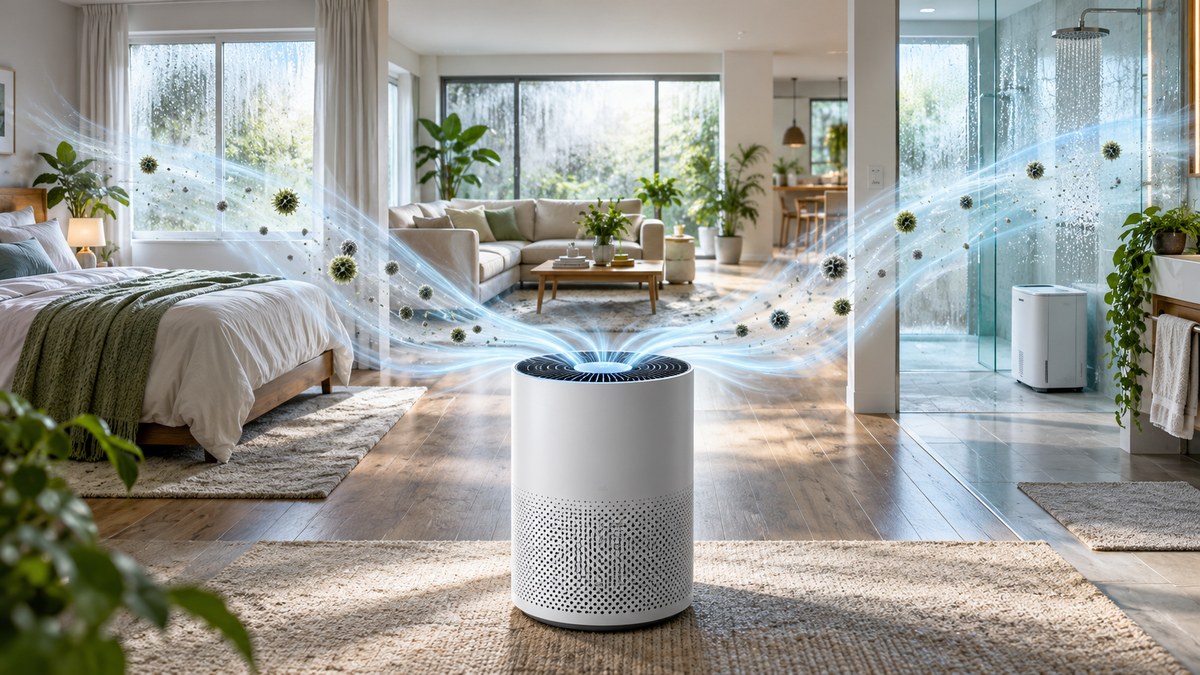
You pull open the basement door and that musty smell hits you like a wall. Or maybe you notice a dark spot creeping along the bathroom caulk. Mold spores are invisible, but they travel through your home’s air every single day. If you live in a humid climate like the Southeast or along the Gulf Coast, you are fighting a constant battle against moisture. The right air purifier can be your best weapon, but only if you choose the correct model and place it in the right spot. This guide will help you find the best air purifier for mold spores and build a room by room defense plan that actually works.
To win against mold spores, you need a true HEPA air purifier paired with moisture control. Not all purifiers are built for this job. Look for a CADR rating that matches your room size, a washable pre-filter for capturing larger particles, and a unit that runs 24/7. Place one purifier in each zone where mold thrives: the basement, the bathroom, and the master bedroom. This layered approach stops spores before they settle.
Why Mold Spores Need a Special Air Purifier
Standard dust collectors won’t cut it here. Mold spores are tiny, typically measuring between 1 and 10 microns. A quality air purifier for mold must use a true HEPA filter, which traps at least 99.97 percent of particles as small as 0.3 microns. That baseline is non-negotiable.
But filtration is only half the battle. Mold needs moisture to grow. If your home sits at 60 percent humidity or higher, spores will keep reproducing no matter how many air purifiers you run. That is why the best strategy pairs air purification with dehumidification. You can read more about pairing these tools in our guide to improve indoor air quality with the best air purifiers for your home.
What to Look for in an Air Purifier for Mold
Before you shop, understand the specs that matter. Here is a breakdown of the features that separate a good mold fighter from a waste of money.
| Feature | Why It Matters for Mold | What to Avoid |
|---|---|---|
| True HEPA Filter | Traps spores as small as 0.3 microns | “HEPA type” or “HEPA like” filters (less effective) |
| Activated Carbon Layer | Absorbs the musty odor mold leaves behind | Units with no carbon or a thin carbon pad |
| High CADR Rating | Cleans the room volume faster | A CADR below 200 for rooms over 300 square feet |
| Washable Pre-Filter | Captures dust and pet hair so the HEPA lasts longer | No pre-filter (clogs the main filter too fast) |
| 24/7 Operation | Keeps spore levels low around the clock | Units with loud fans that you turn off at night |
One more thing: check the filter replacement cost. Some brands sell cheap units but charge a fortune for replacement filters. A purifier that costs $50 to refill every six months is more sustainable than one that hits $120 per swap.
The Room by Room Defense Plan
Mold spores don’t spread evenly. They concentrate in specific zones based on moisture and airflow. Here is how to deploy your air purifiers where they matter most.
1. The Basement or Crawl Space
Basements are ground zero for mold in humid homes. They stay cool, dark, and damp. If you have a finished basement, place a large capacity air purifier near the wall where you notice the most musty smell. For unfinished spaces, you might need a unit rated for 500 square feet or more.
Run this purifier on high for the first week to knock down the baseline spore count. After that, keep it on medium speed around the clock. Pair it with a dehumidifier set to 50 percent. Our guide on top tips for choosing the best dehumidifier for your home can help you pick the right model.
2. The Bathroom
Bathrooms are tricky because steam and moisture are a daily event. A small to medium air purifier placed on a counter or shelf can help, but it must be at least three feet away from the shower to avoid direct steam exposure.
Choose a model with a washable pre-filter. Bathroom air contains hair products, skin cells, and humidity that will clog a standard filter fast. Clean the pre-filter every two weeks. Replace the main HEPA filter every four months instead of the standard six.
3. The Master Bedroom
You spend a third of your life breathing in your bedroom. If mold spores are present, your body reacts while you sleep. Morning congestion, scratchy throat, or a stuffy nose are common signs.
Place a quiet air purifier for mold near the head of the bed, about two feet off the floor on a nightstand or dresser. This placement lets the unit capture the air you breathe most directly. Look for a model with a sleep mode that dims the lights and drops the fan speed to a whisper. You can learn more about this in our guide to how to choose a quiet air purifier for your bedroom in 2026.
4. The Living Room or Open Concept Area
Open floor plans are harder to protect because spores drift freely between zones. A single air purifier rated for the total square footage can work, but you must place it in the center of the space.
Avoid shoving it into a corner. Air purifiers need clearance on all sides to pull air in. Keep it at least 12 inches from any wall or furniture. If your living room connects to a kitchen, choose a model with a strong carbon filter to also handle cooking odors.
How to Set Up Your Purifier for Maximum Spore Capture
You can own the best air purifier for mold spores on the market, but if you set it up wrong, it won’t do much. Follow these steps to get the most out of your unit.
-
Run it 24 hours a day for the first week. Mold spores settle fast. Continuous operation creates a negative pressure zone that pulls spores out of the air before they land on surfaces.
-
Close the windows. This sounds obvious, but many homeowners open windows for fresh air without realizing they are letting in humid outdoor air that carries new spores. Keep the home sealed during high humidity months.
-
Change the filter on a schedule. Set a calendar reminder. HEPA filters that are clogged cannot trap new particles. Mark the date you install each filter and stick to the replacement window.
-
Vacuum and dust before you run the purifier. If you stir up dust while the purifier is running, you overwhelm the pre-filter. Clean surfaces first, then let the purifier polish the air.
“An air purifier is a maintenance tool, not a one-time fix. You have to change the filters, clean the pre-filter, and keep humidity below 55 percent. If you skip any of those steps, you are just moving the spores around.” — Indoor air quality specialist, 2026
Common Mistakes That Ruin Your Mold Defense
Even with the right gear, people make errors that sabotage their efforts. Here are the top mistakes to avoid.
- Buying a unit that is too small. A purifier rated for 150 square feet cannot clean a 400 square foot basement. It will run nonstop and never catch up.
- Placing the purifier on the floor. Spores are heavier than dust and tend to settle lower. But placing the unit directly on a carpet restricts airflow. Elevate it on a table or stand.
- Forgetting to check the humidity. If your home stays above 60 percent humidity, you are feeding the mold. The purifier is just a bandaid. Use a hygrometer to track moisture levels.
- Running the unit only when you smell mold. By the time you smell it, spores have been circulating for hours. Run the purifier continuously.
The Best Air Purifier for Mold Spores: Three Models to Consider
I won’t name specific brands here because the market changes fast, but I will tell you what specs to look for in 2026.
For a large basement or open plan, choose a unit with a CADR of 350 or higher, a true HEPA filter, and a pre-filter that you can vacuum. Expect to spend between $250 and $450.
For a bedroom or small bathroom, pick a model with a CADR of 150 to 200. Focus on noise levels under 30 decibels on low speed. These usually cost $150 to $250.
For a whole home approach, consider a system that connects to your HVAC. These are more expensive, starting around $800, but they treat every room at once. You can compare this option in our article on choosing the best air purifier for your home: expert recommendations.
When to Call a Professional
An air purifier handles airborne spores, but it cannot remove active mold growth from walls, ceilings, or HVAC ducts. If you see visible mold covering an area larger than a dinner plate, you need remediation first.
After the mold is removed and the source of moisture is fixed, then bring in your air purifiers to keep the space clean. Running a purifier over active growth is like mopping a floor while the sink is still running.
Your Mold Spore Defense Plan in Practice
Here is a summary of the actions you can take today.
- Measure the humidity in each room with a digital hygrometer.
- Buy a true HEPA air purifier with a CADR that matches each room’s size.
- Place one unit in the basement, one in the bathroom, and one in the bedroom.
- Run all units on high for the first week, then switch to medium continuous.
- Clean pre-filters every two weeks.
- Replace HEPA filters every four to six months.
- Keep windows closed during humid months.
Building a Healthier Home Starts with the Air You Breathe
Mold spores are stubborn, but they are not unbeatable. You do not need to live with that musty smell or the morning congestion that comes with it. By choosing the best air purifier for mold spores and placing it in the right room, you take control of your indoor environment. Pair that with moisture management and a cleaning routine, and your home will feel fresher within days. Start with one room, see the difference, and then expand your defense. Your lungs will thank you.