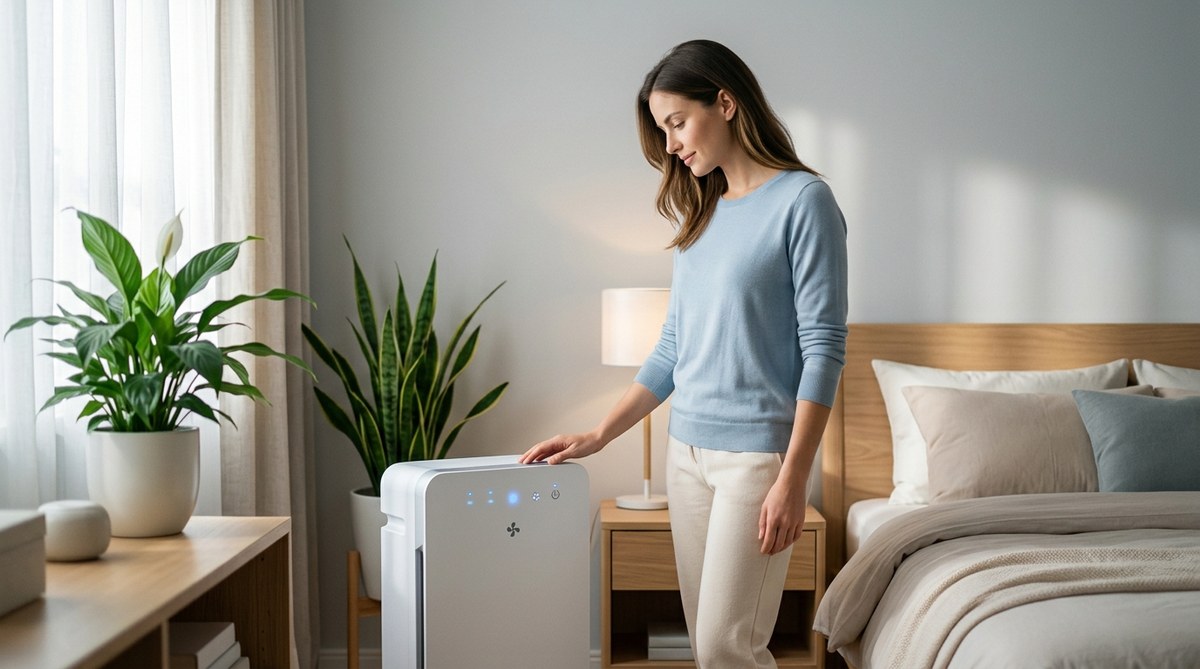
You know that feeling. You finally get into bed after a long day, and the smallest hum or whir becomes the loudest thing in the room. For light sleepers, even a gentle fan can be the difference between drifting off and staring at the ceiling. But you also want cleaner air. The answer? A quiet air purifier for your bedroom in 2026 that works while you sleep, not against you. The good news is that today’s models are quieter and more efficient than ever. Let’s walk through exactly how to choose one that won’t keep you up.
The quietest air purifiers for bedrooms in 2026 use a combination of true HEPA filtration, brushless DC motors, and thoughtful engineering to stay below 25 decibels on low speed. Focus on models with adjustable fan speeds, a sleep mode, and a CADR that matches your room size. Avoid common pitfalls like placing the unit too close to your head or buying a machine that is oversized for the space.
Why noise matters more than you think in the bedroom
Sleep is a delicate thing. Your brain processes sound even when you are unconscious. A steady white noise can help some people sleep, but a fluctuating hum, a rattle, or a sudden motor surge can yank you out of deep sleep. The American Academy of Sleep Medicine recommends bedroom noise levels stay below 30 decibels for optimal rest. That is roughly the sound of a whisper or leaves rustling. Many air purifiers, especially older models, easily hit 40 to 50 decibels on their lowest setting. That is like a quiet conversation happening right next to your pillow.
In 2026, manufacturers have finally started paying attention to this. Brushless DC motors, better fan blade designs, and improved insulation have made it possible to clean the air without the noise. But you still need to know what to look for.
How air purifier noise is measured
Noise is measured in decibels (dB). The scale is logarithmic, which means a jump of 10 dB sounds about twice as loud. A typical quiet bedroom sits around 20 to 30 dB. Here is a quick reference table to help you compare:
| dB range | What it sounds like | Good for sleeping? |
|---|---|---|
| 20-25 dB | Whisper, rustling leaves | Excellent. Barely audible. |
| 25-30 dB | Very soft library hum | Good. Most people won’t notice. |
| 30-35 dB | Quiet refrigerator | Acceptable for some, distracting for light sleepers. |
| 35-40 dB | Rainfall, air conditioner far away | Borderline. May disturb sleep. |
| 40-50 dB | Quiet conversation | Not recommended for bedroom. |
When you shop for a quiet air purifier for your bedroom in 2026, always check the manufacturer’s stated noise level on the lowest fan speed. Many brands list “sleep mode” or “night mode” dB ratings. That is the number that matters most.
Features that make an air purifier truly quiet
Not all “quiet” labels are created equal. Look for these specific features:
- Brushless DC motor: These motors create less friction and noise. They also use less electricity. Most premium quiet purifiers now use them.
- Multiple fan speeds: At least three speeds, with a dedicated low or sleep setting. Some models offer a truly silent mode that drops below 20 dB.
- HEPA filter with low airflow resistance: A high quality HEPA filter allows air to pass through easily, so the fan does not have to work as hard or spin as fast.
- Sealed construction: Gaps and rattling plastic amplify noise. Well built units have rubber feet and tight seams.
- Automatic light sensor or dimmable display: Bright LEDs can also disturb sleep. A model that turns off lights in the dark helps keep your bedroom restful.
“The biggest mistake people make is assuming a higher fan speed is necessary for good air cleaning. In a properly sized bedroom, running the purifier on low speed all night is usually enough to keep particles under control. That is where the quietest performance lives.”
— Jake Morrison, indoor air quality specialist at Fuji Air
Step by step: how to choose a quiet air purifier for your bedroom in 2026
Follow this process to zero in on the right model without getting overwhelmed.
- Measure your bedroom’s square footage. Length times width. Do not include closets or bathrooms. Most bedroom air purifiers are designed for rooms up to 300 square feet. Oversized units create unnecessary noise.
- Check the CADR rating for smoke. CADR (Clean Air Delivery Rate) tells you how fast the machine filters particles. For a bedroom, you want a smoke CADR of at least 100 for a standard sized room. A lower CADR means the fan must run faster and louder.
- Look at the low speed noise level. Find the dB rating on the lowest setting. Anything 25 dB or below is excellent. 30 dB is acceptable if you are not an extremely light sleeper.
- Read real reviews from light sleepers. Manufacturer specs are one thing, but actual user experiences matter. Look for words like “sleep mode,” “silent,” or “barely there” in customer feedback.
- Consider filter replacement costs. Some ultra quiet models use expensive filters. Factor in the annual cost. You do not want to be tempted to run the machine at a higher, louder speed because you are trying to stretch filter life.
- Check for a warranty and customer support. A quiet air purifier should last several years. A good warranty gives you peace of mind.
If you want to learn more about how to match an air purifier to your room size and health needs, read our guide on how to choose an air purifier for asthma and allergy relief.
Common mistakes that make a quiet air purifier noisy
Even the best machine can become disruptive if you set it up wrong. Avoid these pitfalls:
- Placing the unit on a hard, hollow floor. Vibration travels. Put a soft mat or felt pads underneath.
- Blocking the intake or outlet. When airflow is restricted, the fan speeds up to compensate. Keep at least 12 inches of clearance on all sides.
- Running it on high speed all night. Only use high speed during the day or when you first come home. Switch to low or sleep mode before bed.
- Ignoring filter replacement schedules. A clogged filter forces the motor to work harder and louder. Change filters on time.
These mistakes are so common that we wrote a whole article about them. Check out 5 surprising mistakes that ruin your air purifier’s performance for more details.
A quick comparison table of quiet air purifier features
The table below summarizes what to prioritize when you compare models:
| Feature | What to look for | Why it matters |
|---|---|---|
| Motor type | Brushless DC | Less friction, quieter operation |
| Low speed noise | 20-25 dB | Barely audible, does not disturb sleep |
| CADR smoke | At least 100 for rooms up 200 sq ft | Efficient cleaning without needing high fan speed |
| Sleep mode | Yes, with auto dim | Deactivates bright lights and drops to lowest fan |
| Filter cost | Under $50 per year | Encourages regular replacement, keeps noise low |
| Warranty | 3 years or more | Sign of build quality and long term quiet performance |
Why 2026 is a great year to buy a quiet air purifier
The air purifier market has matured. In 2026, even budget models include features that were once reserved for premium units. Brushless motors are standard on most mid range machines. Sleep modes are expected, not optional. And consumers are more aware of noise pollution. Manufacturers have responded by testing their products in real bedroom environments.
If you are still unsure about the technical side, you can read our ultimate guide to HEPA vs UV-C air purifiers to understand what type of filtration works best for your bedroom.
Also keep in mind that a quiet air purifier is only part of the equation. You can further improve your indoor air quality with simple home environment upgrades like keeping windows closed during high pollen days and vacuuming with a HEPA filter.
How to test a quiet air purifier before you buy
If you are shopping online, you cannot listen to the machine in person. But you can get close. Look for video reviews where the reviewer holds a decibel meter next to the purifier. Many independent reviewers on YouTube do this. Watch the video with headphones to get a sense of the sound quality. A low dB number does not always mean the sound is pleasant. Some purifiers produce a low frequency hum that can be more irritating than a higher pitched whir.
If possible, buy from a retailer with a generous return policy. Set the purifier up in your bedroom for a night or two. If it bothers you, send it back. Many stores offer 30 day returns in 2026.
Your quiet bedroom awaits
Choosing a quiet air purifier for your bedroom in 2026 does not have to be a guessing game. Focus on low speed decibel ratings, a brushless DC motor, and a CADR that matches your room size. Avoid the common setup mistakes. And remember that the quietest setting is usually all you need for healthy air while you sleep.
Your bedroom should be a sanctuary. A well chosen air purifier will clean the air without stealing your rest. Give yourself a few nights to adjust. Most people find that the gentle whisper of a quality purifier actually becomes a comforting part of their sleep routine. And that is the kind of change you can feel every morning.