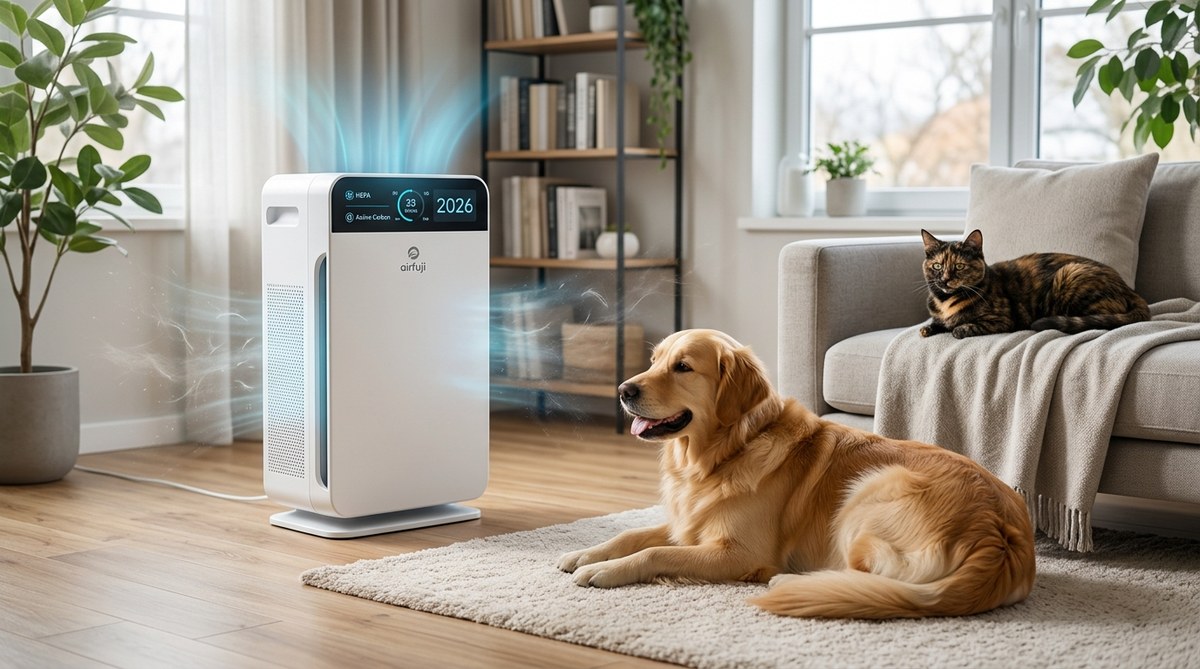
If you share your home with a cat or dog, you already know the trade off. That wet dog smell after a rainy walk. The fine dust that settles on every surface no matter how often you vacuum. The sneezing that starts the moment your golden retriever curls up on the couch. Pet dander, hair, and odors are more than just annoyances. They circulate through your HVAC system and land on your furniture, your bedding, and inside your lungs. The good news is that a well chosen air purifier can handle all three problems at once. But not every model is built for the job. Some struggle with pet hair. Others lack the carbon filtration needed to trap odors. If you want the best air purifier for pets 2026, you need to look beyond the marketing claims and focus on the specs that actually matter.
The best air purifier for pets in 2026 must combine true HEPA filtration with a washable pre-filter for hair and a dense activated carbon layer for odors. Look for a CADR rating that matches your room size, and choose a model with noise levels under 50 dB for bedroom use. Skip ionizers that produce ozone. Focus on filters you can replace easily and affordably.
Why Pets Make Indoor Air Quality Worse
Dogs and cats release dander constantly. These are tiny flakes of skin that are light enough to stay airborne for hours. Add in saliva particles, urine molecules from accidents, and the smell of wet fur, and you have a cocktail of indoor pollutants that can trigger allergies and make your home feel stuffy.
Many pet owners assume that vacuuming and dusting are enough. But standard cleaning misses the microscopic particles floating in the air. An air purifier designed for pets captures those particles before you breathe them in. That is especially important if anyone in your household has asthma or seasonal allergies.
Here is a look at the three main pet related pollutants you need to tackle.
| Pollutant | Source | Size | Best Filter Type |
|---|---|---|---|
| Pet dander | Dead skin flakes | 0.5 to 5 microns | True HEPA |
| Pet hair | Shed fur | 10 to 100 microns | Washable pre-filter |
| Pet odors | Urine, saliva, glands | Molecular level | Activated carbon |
What to Look for in the Best Air Purifier for Pets 2026
Not every air purifier on the shelf can handle the demands of a home with animals. Here are the five features that separate the effective models from the ones that will leave you disappointed.
1. True HEPA Filtration
This is non negotiable. True HEPA filters trap at least 99.97 percent of particles as small as 0.3 microns. Pet dander falls right into that range. Some brands sell filters labeled “HEPA type” or “HEPA style.” Those are not held to the same standard. Stick with True HEPA only.
2. A Washable Pre-Filter
Pet hair is large and fibrous. It will clog a standard HEPA filter fast if there is no barrier to catch it first. A washable pre-filter acts as that first line of defense. You rinse it under water every few weeks, and the main filter lasts much longer. This alone can save you a lot of money on replacement costs.
3. Dense Activated Carbon for Odors
Many air purifiers include a thin carbon layer that barely touches smells. You want a unit with a thick, pelletized carbon filter. That type has more surface area to absorb the volatile organic compounds from pet urine, litter boxes, and wet fur. If you have a multi pet home, this feature is critical.
4. The Right CADR for Your Room
CADR stands for Clean Air Delivery Rate. It tells you how many cubic feet of air the unit can clean per minute. A good rule of thumb is to pick a model with a CADR number that is at least two thirds of your room’s square footage. For a 300 square foot living room, aim for a CADR of 200 or higher.
5. Quiet Operation at Night
Pets often sleep in bedrooms. So do you. If the purifier is too loud on its highest setting, you will run it on low and lose performance. Look for models that stay under 50 decibels on the medium setting. Many modern units also have a sleep mode that dims the lights and cuts noise even further.
If you want a deeper breakdown of each spec, check out this guide on 7 key features to look for in an air purifier in 2026.
Common Mistakes Pet Owners Make When Buying an Air Purifier
Even well intentioned buyers sometimes end up with the wrong machine. Here are the most frequent errors and how to avoid them.
- Choosing a model that is too small for the room. Undersized units run constantly and still fail to clean the air.
- Ignoring filter replacement costs. Some brands charge a premium for proprietary filters. Check the annual cost before you buy.
- Placing the unit in a corner or behind furniture. Air purifiers need clearance on all sides to pull in air properly.
- Running the unit only during the day. Airborne dander spikes at night when pets are active in bedrooms.
- Buying a unit with an ionizer. Ionizers produce ozone, which can irritate lungs and make asthma worse.
For more details on setup mistakes, read this article on why your air purifier isn’t working as well as it should and how to fix it.
How to Choose the Right Size Air Purifier for Each Room
You do not need one massive unit for the whole house. In most cases, it is smarter to place separate units in the rooms where your pets spend the most time. That usually means the living room, the bedroom, and maybe a home office.
Here is a simple process to match the purifier to the space.
- Measure the length and width of the room in feet. Multiply them to get the square footage.
- Multiply the square footage by the ceiling height (standard is 8 feet) to get cubic feet.
- Divide the cubic feet by 4. That is the minimum CFM (cubic feet per minute) you need from the purifier.
- Check the manufacturer’s recommended room size, but subtract 20 percent for homes with pets. Pet hair and dander load the filter faster, so you want a buffer.
For example, a 12 by 14 foot room with 8 foot ceilings is 1344 cubic feet. Divide by 4, and you need a unit that moves at least 336 CFM. That is a medium to large unit.
If you want help calculating the right size for every room in your home, see this guide on how to calculate the right air purifier size for every room in your home.
Maintenance Tips That Extend Filter Life
An air purifier for pets requires more upkeep than one in a pet free home. That is just the reality. But a little routine care can double the life of your filters.
- Rinse the pre-filter every two to three weeks. Let it dry completely before reinstalling.
- Vacuum the outer intake vents monthly. Hair and dust build up there and block airflow.
- Replace the HEPA filter according to the manufacturer schedule, but check it visually every three months. If it looks dark gray or clogged, swap it early.
- Keep the unit away from litter boxes and pet beds. Direct proximity to heavy dust sources overloads the filter fast.
“The number one mistake I see is people forgetting to clean the pre-filter. A clogged pre-filter makes the motor work harder, burns more electricity, and reduces the lifespan of the HEPA filter by months. Set a reminder on your phone and stick to it.” — HVAC technician with 18 years of experience
Is a Smart Air Purifier Worth the Extra Cost in 2026?
Many new models include Wi Fi connectivity, air quality sensors, and app controls. You can check your indoor air quality from your phone, set schedules, and get filter change alerts. For pet owners, this can be genuinely useful. Air quality sensors detect spikes in particulate matter when your dog shakes off after a walk or when the cat uses the litter box. The unit adjusts its fan speed automatically.
Smart features also let you set a pet friendly schedule. For instance, you can boost the fan speed during the hours your pets are most active and drop it to silent mode when you sleep.
That said, the core filtration hardware matters more than the app. Do not pay extra for smart features if the underlying filter system is weak. Read this comparison of is a smart air purifier worth the investment in 2026 before you decide.
A Final Word on Breathing Easier With Pets at Home
You do not have to choose between having a pet and having clean air. The right purifier handles both. Focus on True HEPA, a washable pre-filter, and thick carbon for odors. Match the size to your room and place the unit where it can pull air freely. Stay on top of pre-filter cleaning and you will keep your HEPA filter running at peak performance for longer.
If you are still unsure where to start, take a look at our list of top air purifiers for allergies and asthma relief in 2026. Many of those models double as excellent pet purifiers. Your home should feel fresh, even with a furry companion by your side. With a little planning and the right machine, you can get there.