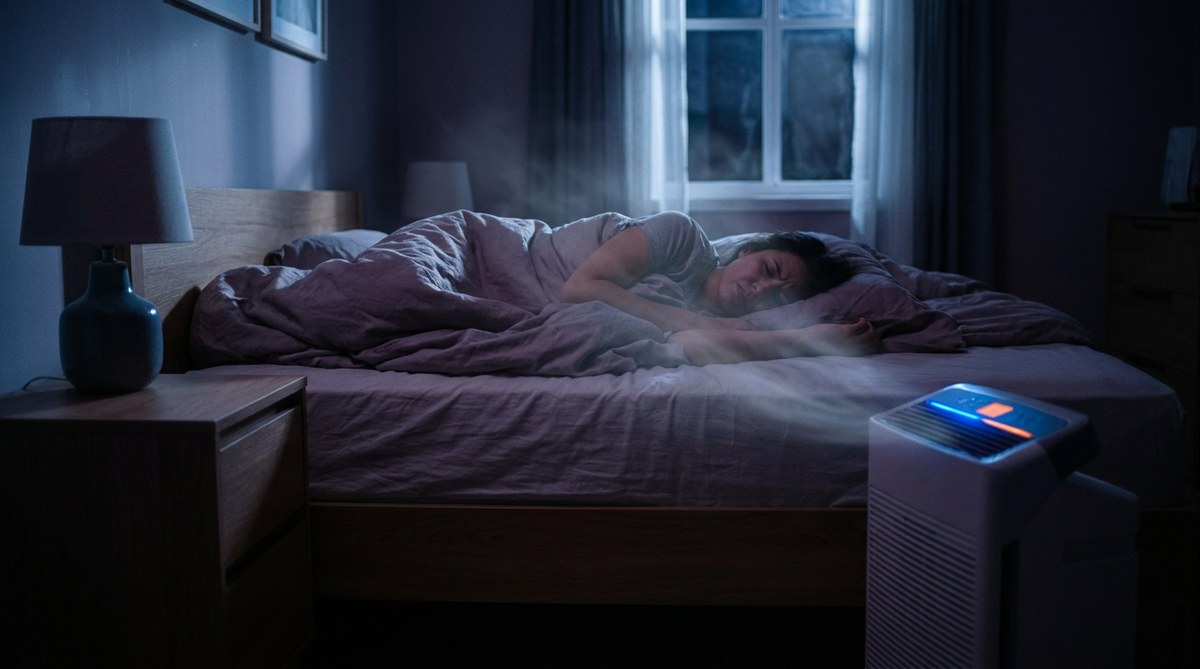
You bought an air purifier to help you breathe easier at night. You wanted cleaner air, fewer allergens, and maybe even relief from that morning stuffiness. But lately, you are waking up groggy, restless, or with a dry throat. You might be wondering if the very machine meant to help you is actually making your sleep worse.
The truth is, not all air purifiers are created equal. And the wrong one in your bedroom can do more than just annoy you with a hum. It can actively disrupt your sleep quality. Let us look at how that happens and what you can do to get the rest you deserve.
A poorly chosen air purifier can harm your sleep through loud noise, harsh airflow, and even ozone emissions. The fix is not to ditch the purifier. It is to pick one with a quiet fan, a true HEPA filter, and a low air speed setting. Placing it at least three feet from your head also helps. The right purifier will clean your air without waking you up.
How a Bad Air Purifier Steals Your Sleep
You might think any air purifier is better than none. But certain features can turn your sanctuary into a source of sleep trouble. Here are the main ways a poor choice can backfire.
Noise That Keeps Your Brain on Alert
A constant whir or a high-pitched whine might seem easy to ignore. But your brain does not ignore it. Even at low volumes, inconsistent fan noise can prevent you from falling into a deep sleep. Studies show that nighttime noise, even at levels below 40 decibels, can increase the time it takes to fall asleep and reduce REM cycles.
Many cheap purifiers use fans that are not balanced well. They create a noise that changes pitch with the motor speed. This unpredictable sound is worse for sleep than a steady white noise. If your purifier sounds like a small vacuum cleaner, it is likely hurting your rest.
The Draft That Dries You Out
Have you ever woken up with a dry nose, scratchy throat, or irritated eyes? That could be your air purifier. Machines that push air out at high speed, especially if placed too close to your bed, create a constant draft. This airflow strips moisture from your mucous membranes.
Your body needs a certain level of humidity to keep your throat and nasal passages comfortable. A direct blast of air, even if it is clean, can dehydrate you overnight. This leads to waking up thirsty and congested, which is the opposite of what you wanted.
Ozone: The Invisible Sleep Disruptor
This is a serious one. Some air purifiers, particularly older models or those using ionic or electrostatic technology, produce ozone as a byproduct. Ozone is a lung irritant. Even at low levels, it can cause coughing, chest tightness, and throat irritation.
The Environmental Protection Agency has warned about ozone generators for years. Breathing in ozone while you sleep can trigger inflammation in your airways. For someone with allergies or asthma, this is a recipe for a night of tossing and turning. You should always check if your purifier is certified as ozone free.
The Right Way to Choose a Purifier for Sleep
You do not need to give up on cleaner air. You just need to be smarter about what you bring into your bedroom. Here is a simple checklist to follow.
- Look for a true HEPA filter. This is non negotiable. A mechanical HEPA filter traps particles without creating ozone. Avoid ionizers or “plasma” technologies for your bedroom.
- Check the noise rating. Look for a decibel rating at the lowest fan speed. Anything under 25 dB is great. Under 30 dB is acceptable. If the spec sheet does not list noise levels, that is a red flag.
- Make sure it has a “Sleep” or “Night” mode. This setting lowers the fan speed and dims all indicator lights. A dark room is critical for melatonin production.
- Measure the airflow direction. You want a purifier that vents air upward or away from your bed. Avoid units that blow air directly out the front.
- Read the filter replacement cost. A cheap purifier with expensive filters might tempt you to skip changes. A dirty filter makes the fan work harder and louder.
The Big Mistake: Placement and Speed
Even a great purifier can cause problems if you set it up wrong. The most common error is putting it right on the nightstand next to your head. This turns a gentle air cleaner into a personal fan.
Here is a table to show you what works and what does not.
| Goal | Mistake to Avoid | Better Approach |
|---|---|---|
| Reduce noise | Placing it on a hard surface like a wooden nightstand | Place it on a soft rug or a vibration absorbing pad |
| Avoid drafts | Pointing the vent toward your pillow | Angle the vent toward the center of the room |
| Maintain humidity | Running it on high all night | Use the lowest effective speed setting |
| Minimize light | Keeping it near the bed with bright LEDs | Cover the lights with tape or choose a unit with a light off mode |
| Improve air quality | Closing the bedroom door completely | Leave the door slightly open for air exchange |
What to Look for When You Shop
If you are shopping for a new purifier, or if you want to check if your current one is the problem, focus on these features. They make the difference between a good night and a bad one.
- Fan speed control. You need at least three settings. The lowest setting should be barely audible.
- Auto mode with a light sensor. Some purifiers dim their display when the room gets dark. This is a sign of a well designed product.
- Carbon pre filter. This helps with odors and VOCs without adding noise. It also extends the life of the HEPA filter.
- A clean air delivery rate (CADR) that matches your room. Oversizing is a common mistake. A unit that is too powerful for a small bedroom will cycle air too fast and create drafts. A unit that is too small will run on high all night.
“The goal of a bedroom air purifier is to be felt only by your lungs, not by your ears or skin. If you can feel the air moving on your face, it is too close or too strong.” — Sleep hygiene expert, Dr. Sarah Chen
A Simple Three Step Test for Your Current Purifier
Not sure if your current machine is the culprit? Try this test tonight.
- Turn the purifier off for one night. Note how you sleep. Do you fall asleep faster? Do you wake up less?
- The next night, turn it back on, but move it at least four feet away from your bed. Set it to the lowest speed. Note any difference.
- On the third night, move it back to its original spot and run it on medium. Compare all three nights.
This test will tell you very quickly if your purifier is helping or hurting. Many people find that distance and speed are the two biggest factors.
When to Replace Your Current Unit
Sometimes the fix is not a new placement. Sometimes the machine itself is the problem. Here are signs that it is time to upgrade.
- It uses an ionizer or ozone producing technology.
- The fan is loud even on the lowest setting.
- You cannot turn off the blue or green indicator lights.
- The filter is hard to find or very expensive.
- The unit is more than five years old and uses older technology.
If any of these apply, you are probably fighting a losing battle. A newer model designed for quiet operation will pay for itself in better sleep.
How to Make Any Purifier Work Better at Night
Even if you are stuck with a less than ideal purifier for now, you can still improve things.
- Put a towel under it. This dampens vibration noise.
- Point the vents toward a wall. This diffuses the airflow and reduces the draft.
- Run it on high during the day. Clean the air while you are awake. Switch to low or sleep mode an hour before bed.
- Clean the pre filter every two weeks. A clogged filter makes the fan work harder and louder.
These small changes can turn a noisy disruptor into a silent helper. For more ideas on getting the most out of your setup, read our guide on how to maximize air purifier effectiveness for a healthier home in 2026.
The Link Between Clean Air and Deep Sleep
Let us be clear. Clean air is good for sleep. Removing pollen, dust mites, pet dander, and mold spores can reduce nighttime congestion and coughing. That is why you bought the purifier in the first place. The problem is never the idea of cleaning the air. It is the execution.
A well designed purifier with a true HEPA filter, a quiet fan, and smart placement will lower your allergen load without waking you up. You will breathe easier and stay asleep longer. The key is to make sure the cure is not worse than the disease.
If you are concerned about allergens specifically, check out our recommendations for top air purifiers for allergies and asthma relief in 2026. They focus on the features that matter most for sensitive sleepers.
Your Bedroom Should Be a Sleep Sanctuary
You have enough things keeping you up at night. Your air purifier should not be one of them. By choosing a quiet, ozone free model with a gentle fan and placing it thoughtfully, you can have both clean air and deep sleep.
Start tonight. Move your purifier a few feet away. Turn it down to the lowest setting. See if you wake up feeling more rested. Your body will thank you. And if you are in the market for a new one, use the checklist above to find a unit that works with your sleep, not against it.
For more tips on creating a healthier home environment, take a look at our guide on improve indoor air quality with the best air purifiers for your home. Good sleep starts with good air, but it takes the right machine to deliver both.