markdown
You plug in your air purifier, set it to high, and walk away. Days go by. Maybe weeks. The fan hums, but is it actually doing its job? Many homeowners and renters in the United States run their purifiers faithfully without ever knowing if the air is getting cleaner. It is a real blind spot, and the good news is you can check it yourself with a simple test that takes less than five minutes.
You can verify your air purifier is working by holding a piece of tissue paper against the intake grille. If the tissue sticks firmly without falling, the fan is pulling air properly. For deeper checking, run the unit on high in a closed room and use a laser particle counter to measure before and after readings. Change filters regularly and keep airflow paths clear.
Why You Might Doubt Your Air Purifier
Let’s be honest. Air purifiers are mostly silent workers. You do not see the dust they trap (unless you inspect the filter). You do not smell the difference unless you had a strong odor before. That lack of feedback can make anyone wonder if the money was worth it.
A few common red flags:
– Your allergies or asthma symptoms haven’t improved.
– You notice visible dust settling on surfaces near the unit.
– The room still smells stale after hours of running.
– The fan sounds quieter than it used to (sign of clogged filter).
– The LED indicator says “clean” but you doubt the reading.
If any of these sound familiar, you are right to question whether your air purifier is working. Let’s figure it out together.
The Tissue Paper Test (Easiest DIY Check)
This test tells you if your purifier is moving air effectively. It works for any brand, any size.
What you need: a single sheet of tissue paper (or a piece of thin paper like a receipt).
Step by step:
- Turn your air purifier to its highest fan speed.
- Hold the tissue paper against the intake grille (usually on the front, back, or sides).
- Let go. If the tissue stays stuck to the grille without falling, the fan is pulling air at the expected rate.
- If the tissue drops immediately or flutters weakly, something is blocking airflow or the fan motor is failing.
This test shows you whether the machine is actually drawing air into the filter. A stuck tissue means the fan works. A falling tissue means trouble.
But what if the tissue sticks? Does that guarantee the air is being cleaned? Not exactly. The fan could be moving air, but the filter might be bypassed or too old to trap particles. That is where the next test comes in.
The Laser Particle Counter Test (More Accurate)
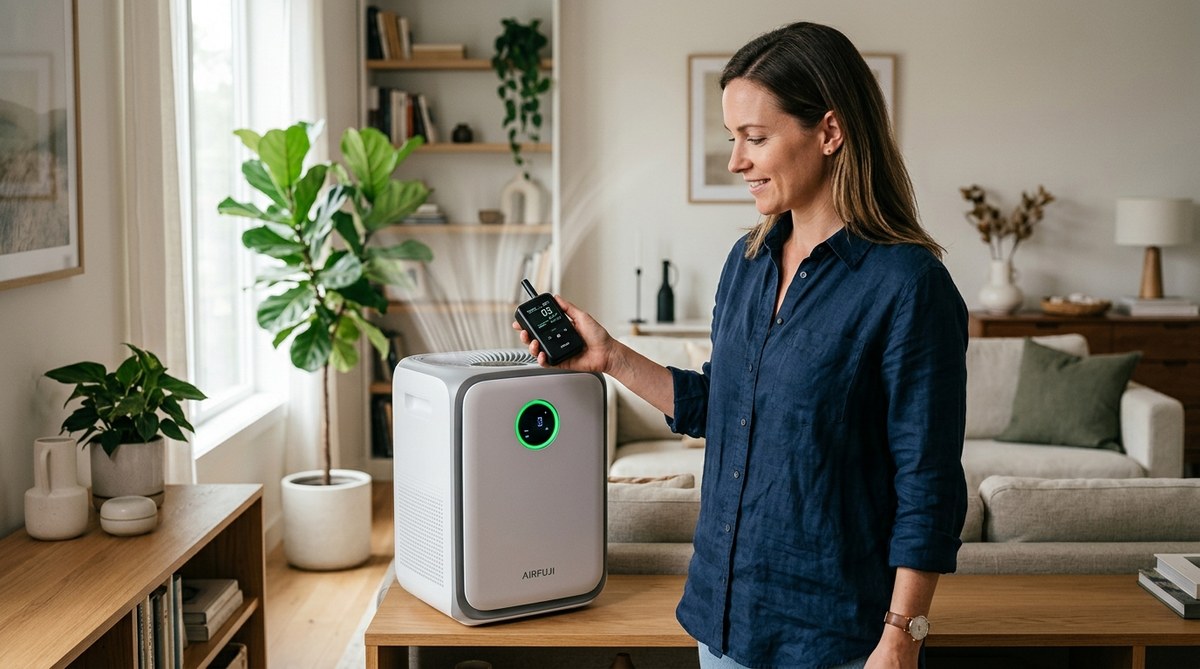
For a scientific check that any curious homeowner can do, rent or buy a laser particle counter. These devices measure the number of particles per cubic foot in different size ranges (PM2.5, PM10, etc.).
Method:
- Close doors and windows in the room. Run the air purifier on “auto” or “low” for 30 minutes.
- Record the particle count near the purifier’s output vent.
- Turn off the purifier. Wait 5 minutes. Measure again in the center of the room.
- Repeat step 3 after another 30 minutes of operation on high speed.
If the purifier is working, the particle count should drop significantly after running (by at least 50% for PM2.5 over an hour). If the numbers stay the same or rise, your unit is not cleaning effectively.
Many library systems in the US now lend particle counters. Check your local public library, or buy one online for about $40. It beats guessing.
Visual and Smell Checks (No Tools Required)
You can also gather clues without any gadgets.
- Inspect the pre-filter. Most purifiers have a washable pre-filter that catches large dust and pet hair. If it is coated in gray fuzz, airflow is restricted. Clean or replace it.
- Check the HEPA filter. Hold it up to a light. If you see gaps, tears, or light shining through easily, the filter is worn out.
- Sniff test. Run the purifier for 10 minutes on high. Then turn it off and sniff the air near the intake. A musty smell often means mold or bacteria growth inside the unit.
- Look for dust accumulation around the room. If you still see dust settling on furniture after a week of 24/7 operation, the unit is not capturing enough particles.
Common Mistakes That Make Your Purifier Seem Broken
Sometimes the purifier is fine, but you are using it wrong. Here are the biggest errors people make.
| Mistake | Why It Hurts Performance | How to Fix |
|---|---|---|
| Placing the unit in a corner | Intake blocked, recirculates dirty air | Move at least 12 inches from any wall |
| Running on low speed all day | May not circulate enough air in large rooms | Use auto mode or run on high for 30 min intermittent |
| Forgetting to close windows | Outside air keeps pollution high | Keep windows shut when purifier is running |
| Using the wrong filter type | Some filters (like carbon only) don’t trap particles | Use a true HEPA filter for particulate removal |
| Ignoring filter replacement schedule | Clogged filter reduces airflow and cleaning efficiency | Replace HEPA every 6-12 months per manufacturer |
When All Else Fails: Troubleshooting Steps
If your purifier still seems ineffective after cleaning and repositioning, run through this checklist:
- Unplug the unit for 30 seconds. Plug back in. Sometimes electronics glitch.
- Remove the front cover and ensure the filter is seated correctly. A misaligned filter lets air bypass.
- Check the fan blade for obstructions. Hair or debris can jam it.
- Listen for unusual grinding or rattling. Those point to a dying motor.
- Verify the unit is sized for your room. A purifier rated for 200 square feet will struggle in a 500 square foot open plan.
“Most air purifier problems come down to three things: a dirty filter, poor placement, or the wrong size. Check those before you assume the unit is broken.” — HVAC technician with 15 years of field experience.
How to Keep Your Purifier Working Well Going Forward
Prevention beats repair. Adopt these habits in 2026:
- Set a calendar reminder to check the filter every 3 months. Write “check air purifier filter” on your phone.
- Vacuum the pre-filter monthly. In homes with pets, do it every two weeks.
- Keep the unit away from curtains, furniture, and bedding.
- Replace the HEPA filter at least once a year. Some units need it every 6 months.
- If you live in wildfire-prone areas (like California, Oregon, or Colorado), consider upgrading to a unit with a carbon pre-filter for smoke.
For more guidance on maintaining your device, see our article on how to maximize air purifier effectiveness for a healthier home in 2026. And if you are in the market for a new model, check our top air purifiers for allergies and asthma relief in 2026.
Putting Your Purifier to the Test Today
You do not need to be a scientist or spend money on expensive equipment. The tissue paper test takes 10 seconds and tells you if airflow is present. The particle counter test gives you hard numbers. And a simple visual check of the filter reveals if it is time for a swap.
Run the test this weekend. If your purifier passes, great. You can rest easy knowing your indoor air is cleaner. If it fails, you now know exactly what to fix. That knowledge alone is worth more than a new filter.
Your lungs will thank you.