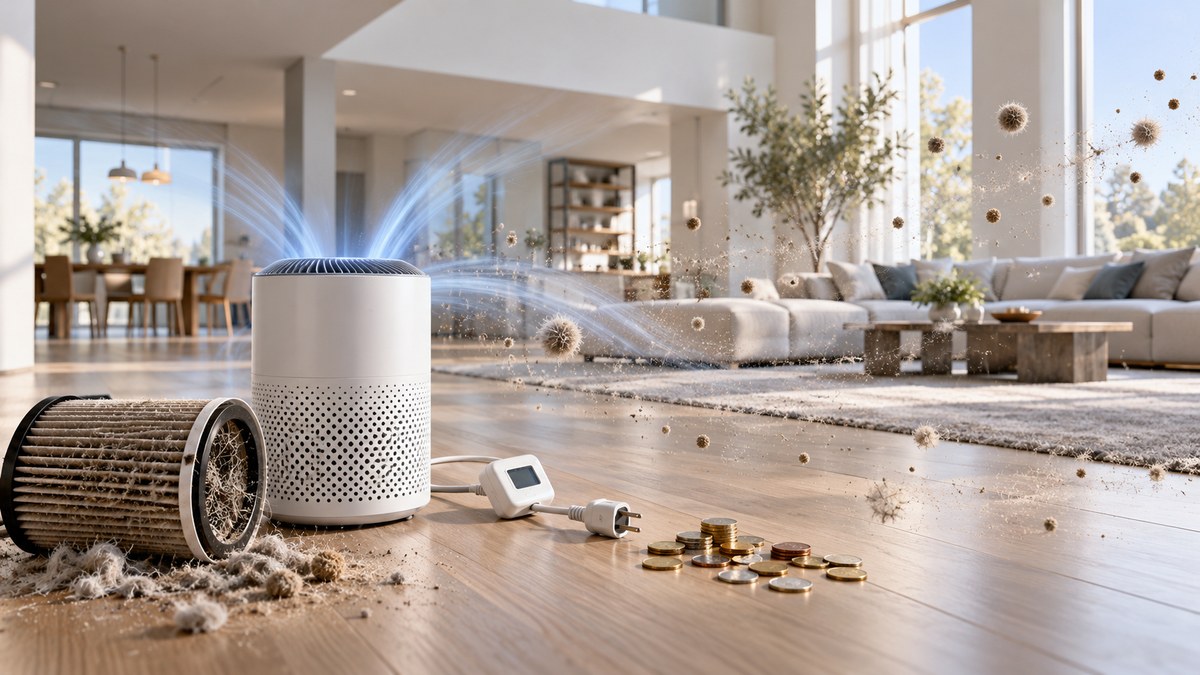
You finally decide to buy an air purifier. Your allergies are acting up, the wildfire smoke is drifting in, or you just want cleaner air for your family. You pick a model, hit purchase, and feel good about the decision. Then the replacement filters arrive six months later and the price tag makes you wince. Your electricity bill seems a little higher too. That initial $150 machine just cost you over $200 in the first year alone. This is the reality for most buyers, and it does not have to be your story.
Most air purifier buying mistakes come down to three things: ignoring filter replacement costs, choosing the wrong size for your room, and believing expensive features are necessary. By focusing on CADR ratings, total yearly cost, and room size, you can cut your annual spending by $200 or more without sacrificing air quality.
The Filter Trap That Costs You Every Year
The biggest mistake people make is buying a machine without checking the price of replacement filters. A $100 air purifier might need $80 filters every six months. A $300 model might use $30 filters that last a full year. Do the math. Over three years, the cheap machine costs $580 total. The pricier one costs $330. You actually save money by spending more upfront.
Here is a rule of thumb. Look at the cost of a three-pack of replacement filters before you buy the unit. If the filter cost is more than half the price of the machine every year, walk away. Many brands make their money on filters, not the hardware. They sell you a cheap box and lock you into expensive consumables.
“The single most important number on an air purifier is not the CADR or the fan speed. It is the annual filter replacement cost. That number determines whether you will actually keep the machine running.” — Industry HVAC specialist with 15 years in indoor air quality.
Room Size Confusion: Bigger Is Not Always Better
Another common air purifier buying mistake is grabbing the largest unit you can find. You think more power equals cleaner air. That is not how it works. An oversized unit in a small room will cycle air too fast, creating drafts and wasting electricity. It also wears out filters sooner because it pulls more dust through them per hour.
A unit that is too small for your space is even worse. It runs constantly at max speed, burns through filters, and never cleans the air properly. You end up running it 24/7 with no real benefit.
How to Match Size to Your Room
Follow this simple process:
- Measure your room length and width in feet. Multiply them to get the square footage.
- Multiply that number by the ceiling height (usually 8 feet). That gives you cubic feet.
- Look for a CADR (Clean Air Delivery Rate) that is at least two-thirds of your room’s square footage. For a 300 square foot room, you want a CADR of 200 or higher for smoke, pollen, and dust.
- If you have high ceilings or open floor plans, add 20 percent to your target CADR.
Do not guess. Use the numbers. It saves you from buying twice.
The Mistake of Chasing Fancy Features
Manufacturers love to add bells and whistles. Wi-Fi connectivity, app control, voice commands, color-changing lights, air quality sensors that beep at you. These features add $50 to $150 to the price tag. Do they clean the air better? No.
A basic HEPA filter with a simple fan does the same job as a smart unit. The sensor on a smart purifier might tell you the air quality score, but you can get a separate monitor for $30 if you really want one. Paying $200 extra for a screen and an app is one of the most expensive air purifier buying mistakes you can make.
Features That Actually Matter
| Feature | Worth Paying For? | Why |
|---|---|---|
| True HEPA filter | Yes | Captures 99.97% of particles at 0.3 microns |
| Activated carbon pre-filter | Yes | Catches odors and extends HEPA life |
| Auto mode with sensor | Maybe | Convenient, but not essential |
| Wi-Fi and app control | No | Adds cost without improving filtration |
| UV-C light | No | Adds cost and minimal benefit for home use |
| Ionizer | No | Can produce ozone and adds no real value |
Stick to the basics. A good fan, a sealed HEPA filter, and a carbon layer. That is all you need.
Energy Waste: Running It Wrong Costs You
Many people run their air purifier on the highest setting all day every day. They think faster is better. In reality, high speed uses significantly more electricity and creates more noise. Most rooms only need the medium or low setting to achieve proper air turnover.
Let us look at the numbers. A typical unit on high draws about 50 watts. On low, it draws 15 watts. Running it 12 hours a day at high costs about $22 per year at average US electricity rates. Running it on low costs about $7. That is a $15 difference, but the real cost comes from filter wear. High speed clogs filters three times faster, which means you replace them sooner.
Run your purifier on medium or low for general use. Only kick it to high when you have a specific issue like cooking smoke or a dusty room. This habit alone can save you $50 to $80 per year on filters.
Placement Problems That Kill Performance
You bought the right size. You picked a model with reasonable filter costs. Then you shoved it behind the couch or in a corner behind a plant. Now it is not working.
Air purifiers need clearance. They pull air from the front or sides and push clean air out the top. If you block the intake or the outflow, you cut performance by half or more. The machine works harder, uses more energy, and still does not clean the room.
Where to Put Your Air Purifier
- Place it at least 3 feet away from walls and furniture.
- Keep it off the floor if possible. A table or shelf at waist height is ideal.
- Do not put it in a closet or behind curtains.
- Position it near the center of the room for best airflow.
- In a bedroom, place it near the bed to clean your breathing zone while you sleep.
If you have pets, keep the purifier away from their bedding and food bowls. Pet dander and fur will clog the pre-filter faster.
The Hidden Cost of Cheap Models
Budget air purifiers under $80 often use permanent or washable filters. The marketing says you never need to buy replacements. That sounds like a deal. In reality, these filters lose efficiency after a few washes. The pores get clogged with fine particles that washing cannot remove. After six months, the unit is basically a fan moving air without cleaning it.
You either buy a new cheap purifier every year, or you live with poor air quality. Neither option saves money. A mid-range purifier with replaceable HEPA filters will outlast three budget units and clean better the whole time.
A Simple Cost Comparison Over 5 Years
- Budget purifier ($70) with washable filter: Buy a new one every 18 months. Total cost: $210 plus electricity.
- Mid-range purifier ($200) with HEPA filters: Replace filters every 12 months at $40 each. Total cost: $200 plus $160 in filters = $360.
- Premium purifier ($500) with long-life filters: Replace filters every 2 years at $60 each. Total cost: $500 plus $120 in filters = $620.
The mid-range option wins on value. It costs $150 more than budget over 5 years but provides consistent, certified filtration the whole time. The premium model costs almost twice as much for marginal improvement.
Filter Replacement Myths That Waste Money
Some people change filters on a strict calendar schedule. Others wait until the unit smells bad or looks dirty. Both approaches cost you.
Changing too early wastes money. A filter that still has life in it gets thrown away. Changing too late means the purifier works harder and blows dirty air back into the room. The indicator light on many units is not reliable. It uses a timer, not a real sensor.
How to Know When to Change the Filter
- Check the filter monthly. If it looks dark gray or brown, it is time.
- Hold the filter up to a light. If you cannot see light through it, replace it.
- Notice a musty smell when the unit runs. That means the filter is saturated.
- Track your usage hours. Most HEPA filters last 6 to 12 months of continuous use.
Do not rely on the machine to tell you. Use your eyes and nose. This simple habit prevents you from replacing filters too early or too late.
The One Feature Most People Overlook
Air purifier buying mistakes often happen because people ignore the pre-filter. A pre-filter is a coarse mesh that catches large particles like dust, pet hair, and lint. It protects the main HEPA filter and extends its life significantly.
Many models include a washable pre-filter. If you clean it every two weeks with a vacuum or a rinse, the HEPA filter can last twice as long. That is a $40 savings per year for ten minutes of work. If the model you are looking at does not have a pre-filter, find one that does. It is the cheapest way to cut ongoing costs.
Check the pre-filter cleaning instructions for your specific model to get the most life out of it.
Smart Shopping Checklist
Before you click buy, run through this checklist:
- What is the annual filter cost? Aim for under $60 per year.
- What is the CADR for smoke? Match it to your room size.
- Does it have a washable pre-filter? Yes is the right answer.
- What is the energy draw on low speed? Look for under 20 watts.
- How loud is it on medium? Check reviews for noise complaints.
- Can you find replacement filters easily? Avoid obscure brands with hard-to-find parts.
If a model fails on filter cost or CADR, skip it. Those two factors determine whether you will be happy a year from now.
Why You Should Not Trust Online Reviews Blindly
Amazon reviews are full of people who just unboxed their purifier and gave it five stars. They have not changed a filter yet. They have not paid an electricity bill yet. Their opinion is worthless for predicting long-term costs.
Look for reviews that mention filter replacement, noise after six months, and customer service experiences. Those are the real stories. A unit with 4.5 stars and 10,000 reviews might still be a poor value if the filters cost $100 every four months.
For a deeper look at which models stand up over time, read our guide to choosing a reliable air purifier for your home.
The Real Cost of Clean Air in 2026
The market has changed. Filter prices have gone up due to supply chain shifts. Some brands have started using proprietary filters that cost more than generic alternatives. A few manufacturers now offer subscription filter services that auto-ship every three months, whether you need them or not. That is a trap.
Avoid any subscription that does not let you adjust the frequency. You want control over when you buy filters, not a surprise box arriving at your door.
If you are unsure about a specific model, check our breakdown of what air purifiers actually remove to make sure the filter type matches your needs.
Putting It All Together to Save $200 a Year
You do not need to be an expert to avoid air purifier buying mistakes. You just need to shift your focus from the purchase price to the total cost of ownership. That means filter replacements, electricity, and how long the machine will last.
A $250 purifier with $40 annual filters and low energy draw will cost you about $330 over five years. A $100 purifier with $80 filters and high energy draw will cost about $580 over the same period. The difference is $250. That is money you can keep in your pocket.
Here is a summary of the mistakes and how to fix them:
- Mistake: Buying based on upfront price only. Fix: Calculate total cost over 3 years.
- Mistake: Choosing the wrong size. Fix: Match CADR to room square footage.
- Mistake: Paying for smart features. Fix: Buy a basic model with good filtration.
- Mistake: Running on high all day. Fix: Use medium or low for daily use.
- Mistake: Ignoring the pre-filter. Fix: Clean it every two weeks.
- Mistake: Following the filter change light. Fix: Check the filter visually.
If you already own a purifier and think you might be making some of these errors, take a look at why your air purifier may not be working as well as it should. You might be able to fix the problem without buying a new unit.
Your Next Step Toward Cleaner Air Without the Waste
You have the knowledge now. The next time you shop for an air purifier, you will not fall for the cheap price trap or the fancy feature bait. You will look at the filter cost first. You will measure your room. You will choose a model with a pre-filter and moderate energy use.
That approach will save you over $200 every year. It will also give you better air quality because you will actually run the machine. When filters are affordable and energy costs are low, you keep the purifier on. That is the whole point.
Start by checking the filter prices for any model you are considering. If they seem high, look at the best air purifiers for allergies and asthma relief in 2026 for models that balance performance with reasonable ongoing costs.
Clean air does not have to be expensive. You just have to buy smart the first time.