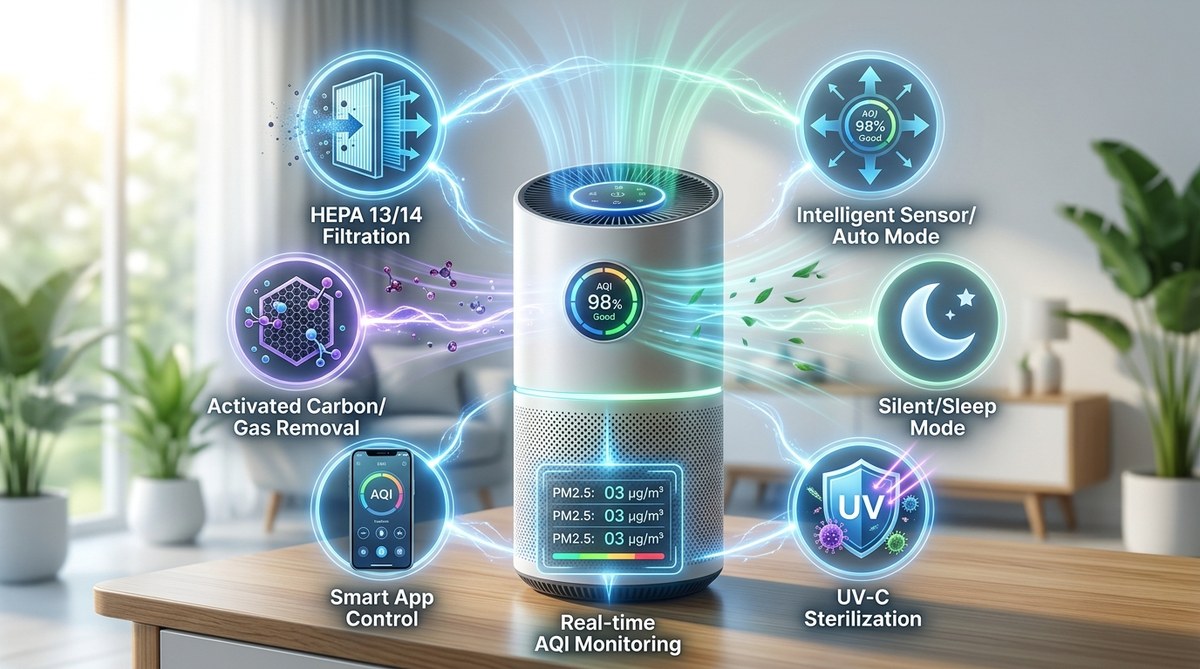
Buying an air purifier in 2026 feels different than it did just a few years ago. The market is packed with options, and every brand claims their machine is the quietest, most efficient, or smartest model on the shelf. But when you strip away the marketing noise, a handful of real features separate a helpful appliance from an expensive paperweight. If you are a homeowner or renter dealing with seasonal allergies, shedding pets, or just wondering what is floating around your living room air, this guide is for you. Here are the seven air purifier features that actually matter in 2026.
Not all air purifiers are built the same. The features that matter most in 2026 include true HEPA filtration, a washable pre-filter, a strong activated carbon layer, smart sensors with auto mode, a quiet fan that won’t disturb sleep, a CADR rating matched to your room size, and low long-term maintenance costs. Focus on these seven, and you will breathe easier without overspending.
True HEPA Filtration Is Non-Negotiable
The single most important feature in any air purifier is the filter itself. Look for a machine that uses true HEPA (High-Efficiency Particulate Air) filtration. True HEPA filters capture at least 99.97 percent of airborne particles that are 0.3 microns in diameter. That includes dust mites, pollen, pet dander, mold spores, and even some bacteria. Some brands use terms like “HEPA-type,” “HEPA-style,” or “HEPA-like” filters. Those are not the same thing. They do not meet the same standard, and they will not deliver the same level of particle removal. If you suffer from allergies or asthma, a true HEPA filter is the baseline you should not compromise on. Every model worth considering in 2026 uses true HEPA as its main filtration layer.
A Washable Pre-Filter Saves You Money
A pre-filter is the coarse layer that catches larger particles before they reach the main HEPA filter. Think of it as a bouncer at the door. It traps hair, lint, dust bunnies, and larger debris. In 2026, the best purifiers include a pre-filter that you can vacuum or rinse under the tap rather than replace. This small feature makes a big difference over time. Instead of buying a new filter every few months, you just clean the pre-filter and keep going. That saves you anywhere from 50 to 150 dollars per year depending on your model. Pet owners especially should prioritize a machine with a sturdy, washable pre-filter. Cat hair and dog fur will clog a standard filter fast. A washable pre-filter extends the life of your main filter and keeps your machine running at peak performance.
Activated Carbon That Actually Has Mass
Many air purifiers advertise an activated carbon filter, but the amount of carbon matters more than the claim. A thin sheet of carbon-coated foam will do very little to remove odors, smoke, or volatile organic compounds (VOCs). You want a filter that has a substantial layer of granular activated carbon. The heavier and thicker the carbon layer, the better it will absorb gases and smells. If you live in a city, cook often, or have a fireplace, this feature becomes even more important. A machine with a generous carbon layer can handle cooking odors, wildfire smoke, and the chemical fumes from cleaning products. In 2026, look for models that list the weight of their carbon filter. Anything less than half a pound of carbon is likely too light to make a real difference.
Smart Sensors and Auto Mode Are Game Changers
One of the most practical features to emerge in the last few years is the combination of real-time air quality sensors and an automatic fan mode. The purifier reads the air in your room, detects spikes in particles or VOCs, and adjusts its fan speed accordingly. You do not have to guess when to turn it up or down. If you are cooking bacon or your dog shakes off after a walk, the sensor picks up the change and the fan ramps up. When the air clears, the fan slows back to a whisper. This feature is especially helpful for people who want to set the machine and forget it. It also saves energy because the purifier only runs at high speed when it needs to. In 2026, the best sensors can distinguish between PM2.5 (fine particles), PM10 (larger particles), VOCs, and humidity. That level of detail gives you confidence that the machine is actually working.
“The smart sensor is the feature I recommend most to friends who are new to air purifiers,” says Rachel Kim, an indoor air quality researcher based in Portland. “It takes the guesswork out of operation and ensures the machine is responding to real conditions in your home, not just running on a timer.”
Noise Level That Lets You Sleep
No one wants a loud machine humming through the bedroom all night. Noise is measured in decibels (dB), and the difference between 25 dB and 45 dB is significant. A good rule of thumb is to look for a purifier that operates at 30 dB or below on its lowest (sleep) setting. That is quieter than a whisper and should not disturb your rest. On the highest setting, most machines will be louder. That is fine for daytime use when you are awake and moving around. But for nighttime use, a quiet sleep mode is essential. Many 2026 models include a dedicated sleep mode that dims all lights, drops the fan to its lowest speed, and disables any beeps or tones. If you are a light sleeper, this feature alone can make the difference between loving your purifier and returning it. Check reviews for real-world noise measurements, not just the manufacturer’s claims.
CADR Rating Matched to Your Room Size
CADR stands for Clean Air Delivery Rate. It measures how many cubic feet of air per minute the purifier can clean of three common pollutants: smoke, dust, and pollen. A higher CADR means faster cleaning. The Association of Home Appliance Manufacturers (AHAM) certifies these ratings, and you should only consider models that list their certified CADR numbers. To choose the right size, take your room’s square footage and multiply it by the ceiling height. That gives you the volume. Then look for a purifier with a CADR that is at least two-thirds of that volume. For example, a 300-square-foot room with 8-foot ceilings has 2,400 cubic feet. You would want a purifier with a CADR around 1,600 or higher. In 2026, many top models include their recommended room size on the box, but you can always check the AHAM database to verify. Oversizing a bit is fine. Undersizing means the machine will struggle to keep up.
Here is a quick comparison of how CADR ratings match to different room sizes:
| Room Size (sq ft) | Recommended CADR (smoke) | Typical Fan Speed | Best Use Case |
|---|---|---|---|
| 150 to 250 | 100 to 150 | Low to Medium | Bedroom, small office |
| 250 to 400 | 150 to 250 | Medium to High | Living room, den |
| 400 to 700 | 250 to 350 | High | Open concept, basement |
| 700+ | 350+ | High or dual units | Large open floor plan |
Matching the CADR to your space ensures you get clean air without wasting money on a machine that is too powerful or too weak for the room.
Low Long-Term Maintenance Costs
The purchase price of an air purifier is only half the story. The other half is what you pay for replacement filters over the years. Some machines require new filters every three months. Others can go six to twelve months between changes. Before you buy, check the cost of replacement filters and how often they need to be swapped. A machine that costs 200 dollars but requires 150 dollars in filters every year is not a bargain. In 2026, many brands are moving toward longer-lasting filters. Some use a two-stage system where the pre-filter lasts a year and the HEPA filter lasts two years. Others include a filter life indicator that tells you exactly when to change it, so you never replace a filter that still has life left. Look for models with a filter replacement cost of 50 to 80 dollars per year for typical use. That is a reasonable range. Anything higher should come with a longer filter life to justify the expense.
If you want to see specific models that hit all seven of these features, check out our guide on improve indoor air quality with the best air purifiers for your home. It lists machines that balance performance, noise, and filter costs for different room sizes and budgets.
Three Steps to Test a Purifier Before You Commit
You cannot always test a purifier in a store, but you can do a quick home trial after it arrives. Here is a simple process to verify the machine works for your space:
- Set up the purifier in your main living area and run it on auto mode for 24 hours. Let the sensors calibrate to your home’s normal air quality.
- On the second day, introduce a small source of particles. Cook a slice of toast until it is slightly burnt, or sprinkle a pinch of baking soda near the intake. Watch the sensor reading climb and notice how fast the fan responds.
- Place the purifier in your bedroom at night and check the sleep mode. Can you hear it from your pillow? Do the lights stay off? If the machine disturbs your sleep at the lowest setting, it might not be the right fit for overnight use.
This three-day test tells you more than any spec sheet ever could. If the machine passes, you have found a keeper.
Features You Can Safely Skip
Not every bell and whistle is worth paying for. Here are some features that sound impressive but rarely deliver meaningful benefits for most homes:
- Ionizers or plasma generators that claim to “kill” particles. Many produce trace amounts of ozone, which can irritate lungs.
- UV-C lights inside the purifier. The contact time is usually too short to actually sterilize air.
- App connectivity that does not add real convenience. A basic timer and auto mode matter more than a phone app.
- “Forever filters” that claim to never need replacement. In practice, these often lose efficiency over time and cannot be fully cleaned.
Stick with the seven core features. They are the ones that keep your air clean without unnecessary complexity or hidden costs.
Building a Healthier Home One Breath at a Time
Choosing the right air purifier in 2026 comes down to understanding what each feature actually does for your daily life. True HEPA filtration captures the tiny particles that trigger allergies. A washable pre-filter cuts your ongoing costs. Real activated carbon handles smells and chemicals. Smart sensors let the machine work on autopilot. Quiet operation keeps your sleep undisturbed. A proper CADR rating ensures the room gets cleaned fast. And reasonable filter costs mean you will actually replace them when needed. Focus on these seven features, and you will find a purifier that fits your home, your budget, and your health goals. For more guidance, take a look at our top tips for choosing the right air purifier to reduce allergens and pollutants and start breathing cleaner air tonight.