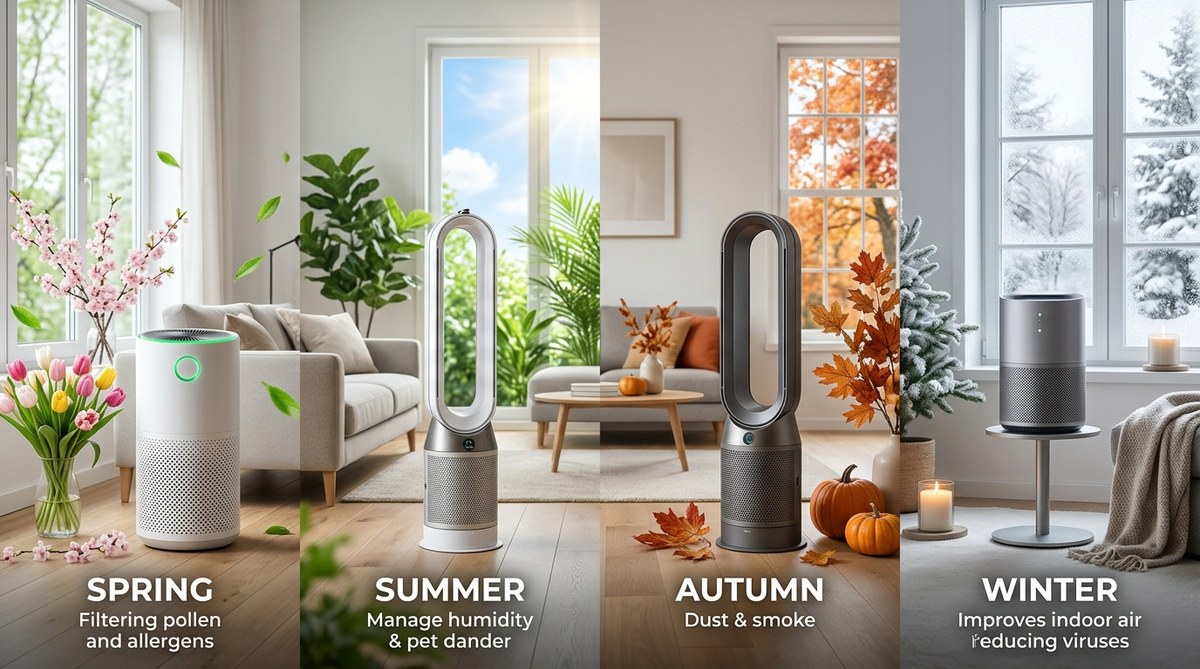
You know that feeling when the seasons change and your home suddenly feels… off. Maybe your eyes get itchy in spring. Maybe your sinuses act up in late summer. Or maybe the air just feels stale and heavy once you close the windows for winter. The truth is, no single air purifier works perfectly all year long. The challenge changes with the weather. Spring brings tree pollen and dampness. Summer unleashes wildfire smoke and high humidity. Fall stirs up ragweed and leaf mold. Winter traps dust, pet dander, and dry air inside your home. So what is the best air purifier for each season? The answer depends on what you are fighting right now. This guide will walk you through a practical, season-by-season plan to keep your indoor air clean all year.
No single air purifier is perfect for every season. For spring, pick a model with a strong pre-filter and a carbon layer to trap pollen and VOCs. Summer calls for a high-CADR unit with a gas filter for wildfire smoke. Fall requires a machine with a True HEPA filter to capture mold spores and ragweed. Winter needs a quiet, energy-efficient purifier with a washable pre-filter to handle dust and pet dander. Match your machine to the season, not the other way around.
Spring: The pollen invasion
Spring is beautiful, but it is also brutal for allergy sufferers. Trees, grasses, and flowers release billions of pollen grains into the air. That pollen finds its way inside through open windows, on your clothes, and even through tiny gaps in your home. On top of that, spring rains increase humidity levels, which can trigger mold growth in basements and bathrooms.
The best air purifier for spring should have a strong pre-filter. This captures large particles like pollen before they reach the main filter. A True HEPA filter is non-negotiable here. It traps 99.97% of particles as small as 0.3 microns, which includes most pollen grains. Look for a model with a carbon pre-filter too. Carbon helps absorb odors from damp spring air and reduces volatile organic compounds (VOCs) that can spike when you start spring cleaning with harsh chemicals.
Here is what to look for in a spring purifier:
- A True HEPA filter (not “HEPA-type” or “HEPA-like”)
- A washable pre-filter to catch larger pollen and extend filter life
- A carbon layer for odor and VOC reduction
- A CADR (Clean Air Delivery Rate) of at least 200 for pollen
One tip: place the purifier in your bedroom first. You spend a third of your life sleeping, and spring pollen counts are highest in the early morning. Running the unit on low speed all night can make a huge difference in how you feel when you wake up.
Summer: Smoke, humidity, and ozone
Summer brings a different set of challenges. Wildfire season has become a regular threat across the western United States, but smoke can drift hundreds of miles. Even if you live in the Midwest or East Coast, you might wake up to hazy skies and the smell of burning wood. Smoke particles are tiny. They are often smaller than 0.3 microns, so they can slip past standard HEPA filters if the seal is not tight.
The best air purifier for summer must have a high CADR for smoke. You want a CADR of at least 300 for smoke, ideally higher. A unit with a sealed HEPA system is critical. This means the filter is fully enclosed so no air bypasses it. You also need a thick activated carbon filter. Smoke contains gases like formaldehyde and benzene, which carbon can absorb.
Summer also means high humidity. Humidity above 60% can make your air purifier work harder because moisture clogs the filters faster. Some purifiers come with built-in dehumidifiers, or you can pair your purifier with a dedicated dehumidifier. If you are dealing with both smoke and humidity, consider a two-in-one unit.
Here are the top features for summer:
| Feature | Why it matters |
|---|---|
| High CADR for smoke (300+) | Captures fine smoke particles fast |
| Sealed HEPA system | Prevents smoke from bypassing the filter |
| Thick carbon filter | Absorbs toxic wildfire gases |
| Auto mode with air quality sensor | Adjusts fan speed when smoke spikes |
| Low energy consumption | Keeps bills down when running 24/7 |
Expert advice: If you live in a wildfire-prone area, buy your summer air purifier in early May. By July, many models sell out or have long shipping delays. Keep a spare set of filters on hand too. Smoke events can clog a filter in weeks, not months.
Fall: Mold, ragweed, and indoor allergens
Fall is a season of transition. The leaves change color, but they also release mold spores as they decay. Ragweed pollen peaks in September and October. And as temperatures drop, you start closing windows, which traps indoor pollutants like dust mites and pet dander.
The best air purifier for fall should focus on mold spores and biological allergens. A True HEPA filter is essential for capturing mold spores, which are typically 1 to 20 microns. But you also need a unit that handles VOCs. Mold produces microbial VOCs (MVOCs), which cause that musty smell. A carbon filter helps here.
Fall is also the season when you might notice more static electricity and dry air. Some purifiers with ionizers or UV-C lights claim to kill mold and bacteria. Be careful with ionizers. They can produce trace amounts of ozone, which is a lung irritant. Stick with a HEPA-based purifier and consider adding a separate humidifier if the air feels dry.
Here is a simple checklist for fall:
- Check the filter type. Only True HEPA or H13/H14 grade.
- Look for a pre-filter that you can vacuum or wash. Leaf dust will clog it fast.
- Choose a model with a high CADR for dust (at least 200).
- Place the unit in the room you use most. For most people, that is the living room.
- Run the purifier on medium speed for at least 8 hours a day.
If you have a basement that feels damp, fall is a good time to add a dehumidifier. Mold thrives in humidity above 55%. Top Tips for Choosing the Best Dehumidifier for Your Home can help you find the right match.
Winter: Trapped air and indoor pollutants
Winter is the season of closed windows, dry air, and recirculated dust. You spend more time indoors. Your heating system blows dust, pet dander, and even mold spores from ducts into your living space. And because you are not opening windows, pollutant concentrations can build up quickly.
The best air purifier for winter does not need the highest CADR for smoke or pollen. Instead, it needs to be quiet and energy efficient. You will run it for long hours, often while you sleep. Noise levels matter. Look for a unit with a noise rating under 50 decibels on low speed. That is about as loud as a quiet library.
Winter also means lower humidity. Dry air can irritate your nasal passages and make you more vulnerable to colds and flu. Some air purifiers have built-in humidifiers, but these can be hard to clean and may grow bacteria. A better approach is to use a separate humidifier. Understanding Dehumidifier Settings to Optimize Indoor Comfort covers the opposite side of humidity control, which can help you balance your home environment.
Here are the winter priorities:
- Low noise (under 50 dB on low)
- Energy Star certified to save on heating bills
- Washable pre-filter to handle dust from heating ducts
- Easy filter replacement (you do not want to freeze changing a filter)
One common mistake is placing the purifier too close to a heat vent. The airflow from the vent can blow dust past the purifier or cause the unit to overheat. Keep at least three feet of space around the unit.
A year-round plan that actually works
You do not need four different air purifiers. You need one versatile machine that you adjust for the season. Or you need two units: one for the bedroom and one for the main living area. Here is how to build your year-round plan.
- Buy a mid-range purifier with a True HEPA filter and a thick carbon layer. This covers spring pollen, summer smoke, and fall mold. Look for a CADR of at least 250 for smoke.
- Add a washable pre-filter. This extends the life of your main filter and saves you money. Clean it every two weeks during spring and fall.
- Use auto mode with a real-time air quality sensor. The purifier will adjust itself when pollen spikes in spring or smoke drifts in during summer.
- Change filters on a seasonal schedule. Replace the carbon filter before summer. Replace the HEPA filter before fall. Mark it on your calendar.
- Pair with a dehumidifier in spring and summer if your indoor humidity stays above 55%.
This table shows the seasonal filter schedule:
| Season | Filter action | Why |
|---|---|---|
| Spring | Clean pre-filter weekly | Pollen loads are high |
| Summer | Replace carbon filter | Smoke gases saturate carbon fast |
| Fall | Vacuum pre-filter often | Leaf dust and mold spores |
| Winter | Check HEPA filter condition | Heavy use for months |
Common mistakes to avoid
Many people buy one air purifier and never change their approach. Here are the most common mistakes and how to fix them.
- Using a small purifier in a large room. A unit rated for 200 square feet will not clean a 500-square-foot living room. Always check the recommended room size.
- Forgetting to change the filter. A clogged filter stops working and can even blow dust back into the room. Set a reminder every six months.
- Placing the purifier in a corner. Air needs to circulate. Place the unit at least 18 inches from walls and furniture.
- Running the purifier only when you are home. It takes time to clean the air. Run it continuously during peak seasons.
- Ignoring humidity. High humidity makes filters clog faster. Low humidity makes you feel stuffy. Keep humidity between 40% and 55%.
If you want to dig deeper into filter care, How to Extend the Life of Your Air Purifier’s Filters and Save Money has practical tips that work for any season.
Build your own seasonal kit
You do not have to buy everything at once. Start with the season you are in right now. If it is spring, focus on a purifier with a strong pre-filter. If it is summer, prioritize smoke CADR. Over time, you can add accessories like a dehumidifier or a second purifier for a different room.
Here is a bullet list of items you might add to your seasonal kit:
- A True HEPA air purifier with carbon filter
- A pack of replacement filters (buy them early)
- A washable pre-filter cover
- A small hygrometer to check humidity
- A dehumidifier for damp seasons
- A quiet fan for air circulation
The goal is not to overcomplicate things. It is to match your equipment to the real challenges each season throws at you.
Putting it all together for healthier air
Your home is your sanctuary. But the air inside it changes dramatically from March to December. Spring pollen, summer smoke, fall mold, and winter dust each require a slightly different approach. The best air purifier for each season is not a magical machine. It is a well-chosen unit that you maintain, adjust, and position correctly. Start with a solid True HEPA model that has a high CADR for smoke and a thick carbon filter. That one machine will carry you through most of the year. Then tweak your routine: clean the pre-filter in spring, replace the carbon before summer, vacuum the pre-filter in fall, and check the HEPA filter in winter.
You deserve to breathe easy no matter what the weather is doing outside. Pick the right tool for the season, keep it running, and enjoy the peace of mind that comes with truly clean indoor air.