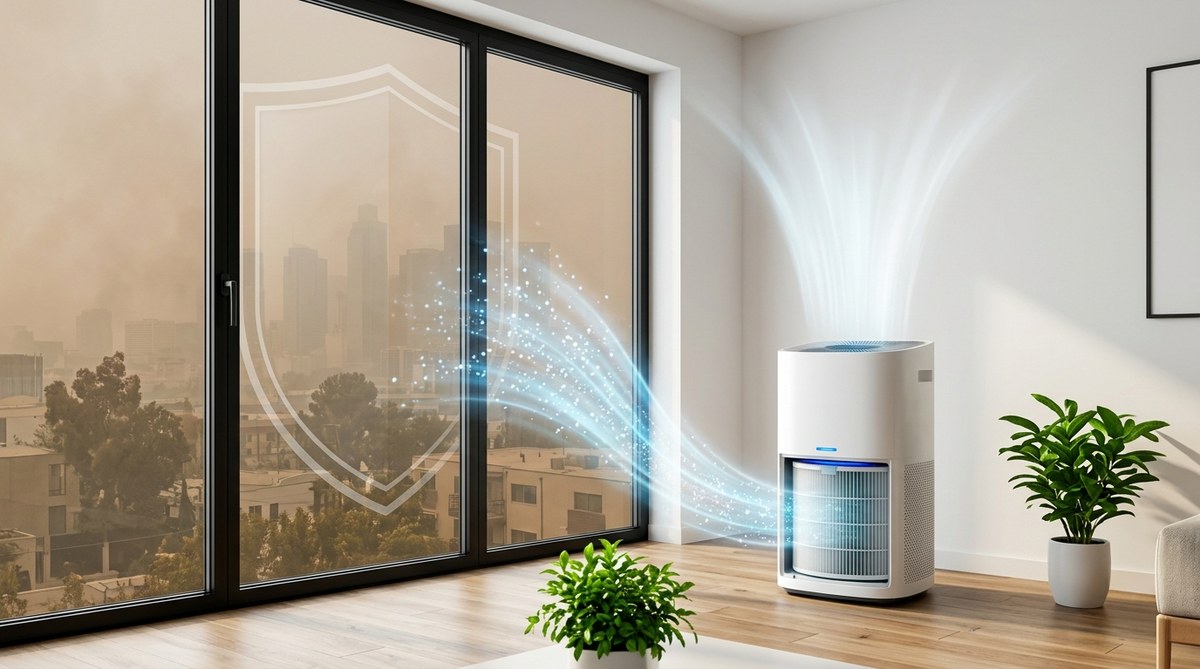
The smell of wildfire smoke creeping into your home is unsettling. It triggers something primal. You know those tiny particles are drifting through your living room, settling on your furniture, and finding their way into your lungs. Your air purifier is your first line of defense, but here is the hard truth: most people do not use theirs correctly. A purifier sitting in the corner with a dirty filter or the wrong settings will not protect your family. With wildfire seasons getting longer and more intense across California, Oregon, and Washington, 2026 is the year to get serious about indoor air quality. Let me show you exactly how to optimize your air purifier for wildfire smoke so your home stays safe.
Wildfire smoke contains harmful fine particles that can penetrate your home and impact your health. Optimizing your air purifier requires more than just turning it on. You need a True HEPA filter with activated carbon, proper placement away from walls, a sealed room, and regular maintenance. This article covers each step so your purifier performs at peak efficiency when wildfire season arrives. These proven strategies will help you breathe safer indoor air all year long.
Why Wildfire Smoke Is Different from Regular Indoor Pollution
Wildfire smoke is not the same as dust, pet dander, or pollen. Those particles are larger and easier to trap. Smoke from a wildfire contains a complex mix of gases and fine particulate matter known as PM2.5. These particles measure 2.5 micrometers or smaller. For context, a single human hair is about 70 micrometers wide. PM2.5 particles are small enough to bypass your body’s natural defenses and enter your bloodstream.
Smoke also carries volatile organic compounds (VOCs). These are gases released by burning trees, vegetation, and structures. VOCs can irritate your eyes, nose, and throat. Some are linked to long term health concerns. A standard air purifier designed for allergens may struggle with smoke because it lacks the ability to trap gases. That is why you need a specific setup to handle both particles and VOCs.
If you want to understand how different purification technologies stack up against smoke and other pollutants, take a look at how to maximize air purifier effectiveness for a healthier home in 2026. It explains the core differences between filtration methods so you can make an informed choice.
Choose the Right Filter for Smoke Removal
Not all filters are built the same. When you are shopping for a filter to handle wildfire smoke, you need two things: a True HEPA filter and a thick activated carbon layer.
True HEPA filters capture at least 99.97 percent of particles that are 0.3 microns in size. That includes PM2.5. Some purifiers advertise “HEPA type” or “HEPA like” filters. Those terms are not regulated. They often let smaller particles slip through. Always look for the words “True HEPA” on the box or product page.
Activated carbon is what removes gases and odors. Smoke smell sticks around because of the VOCs. A thin carbon coating will get saturated within hours. You want a filter with a dense carbon bed. Some models use pelletized carbon, which lasts longer than carbon impregnated foam.
Here is a list of filter characteristics that matter most for wildfire smoke:
- True HEPA rating (not HEPA type)
- High mass of activated carbon (measured in pounds)
- Carbon combined with zeolite for extra VOC absorption
- Pre-filter layer to catch larger ash particles before they reach the main filter
- MERV 13 or higher if you are using a whole house system
If you are unsure which size filter your room needs, read our guide on how to calculate the right air purifier size for every room in your home. Getting the size right is just as important as the filter type.
Place Your Air Purifier in the Right Spot
Placement matters more than most people realize. Put your purifier in the wrong spot and you cut its effectiveness by half. Here are the rules for positioning your unit during wildfire season.
First, keep it away from walls and furniture. Air needs to flow into the intake vents freely. If the purifier is shoved against a wall or tucked behind a couch, the airflow gets blocked. Manufacturers recommend at least three feet of clearance on all sides.
Second, place it in the room where you spend the most time. That is usually the bedroom or the living room. Do not try to clean the whole house with one unit. Focus on one room and seal it off.
Third, elevate the unit slightly. Putting it on a low table or stand helps it pull in smoke particles that settle at breathing height. Avoid placing it directly on the floor if you have carpets, since the intake will suck up dust and debris instead of smoke.
Fourth, keep doors and windows closed. This seems obvious, but during a wildfire event, many people crack a window for fresh air. Do not do it. Outdoor air quality will be worse than indoor air. Your purifier cannot keep up if fresh smoke keeps flowing in.
For a deeper look at positioning strategies and other performance boosters, check out why your air purifier isn’t working as well as it should (and how to fix it). It covers the placement mistakes that even careful homeowners make.
Five Steps to Optimize Your Purifier Before Smoke Arrives
Do not wait until the sky turns orange. Wildfire season is predictable in many parts of the West. Use the calm weeks before peak season to get ready. Follow these five steps to optimize your air purifier for wildfire smoke before the first alert hits your phone.
-
Upgrade your filter now. If your current filter is six months old, replace it. A fresh True HEPA filter with activated carbon will perform dramatically better than a clogged one. Buy at least one backup filter so you are not scrambling during a shortage.
-
Seal your target room. Walk around the room where you plan to run the purifier. Check for gaps under doors, around windows, and along baseboards. Use weather stripping, draft stoppers, or tape to seal those gaps. The tighter the room, the faster your purifier can clean the air.
-
Verify your CADR rating. CADR stands for Clean Air Delivery Rate. It tells you how many cubic feet of air the purifier can clean per minute. For smoke, look for a CADR of at least 200 for a medium sized room. If your unit’s CADR is lower, you may need a second purifier.
-
Pre set your fan schedule. Some purifiers let you set a daily schedule. Program the unit to run on high speed during the afternoon and evening hours when wildfire activity typically peaks. If you have a smart purifier, set it to respond to real time air quality data from a monitor.
-
Stock spare pre-filters. Many purifiers have a washable or replaceable pre-filter that catches large ash and debris. Buy a few extras. During heavy smoke, pre-filters clog faster than you expect. Swapping them out keeps the main HEPA filter working longer.
These steps take less than an afternoon to complete. Doing them early gives you peace of mind and a cleaner home when the smoke arrives. For more advanced tips on getting the most out of your setup, see how to maximize air purifier effectiveness for a healthier home in 2026.
Mistakes That Hurt Your Air Purifier’s Performance
Even with the best purifier, small mistakes can ruin your results. The table below shows the most common errors people make, why each one hurts performance, and how to fix it.
| Mistake | Why It Hurts | How to Fix It |
|---|---|---|
| Running the purifier on low speed | Low speed moves less air, so the room takes much longer to clean. | Run on high or turbo mode during active smoke events. |
| Placing the unit in a corner | Air intake gets blocked, reducing the volume of air processed. | Move it to a central location with 3 feet of clearance on all sides. |
| Ignoring the pre-filter | A clogged pre-filter forces the HEPA filter to work harder and wear out faster. | Clean or replace the pre-filter every two weeks during heavy smoke. |
| Leaving windows open for fresh air | Outdoor smoke pours in faster than the purifier can clean it. | Keep all windows and doors closed. Use a portable AC or fan only if it recirculates indoor air. |
| Using a filter past its expiration date | Old filters lose efficiency and can release trapped particles back into the air. | Replace the filter at the start of each wildfire season and again if smoke lasts more than a month. |
If you recognize any of these mistakes in your own home, do not feel bad. They are incredibly common. The good news is that each fix is simple and costs almost nothing. For a more complete list of slip ups, read our article on are you making these common air purifier mistakes.
How to Build a Clean Air Room in Your Home
A clean air room is a single room where you spend most of your time during a smoke event. It is sealed, equipped with a properly sized purifier, and free from indoor sources of pollution. Here is how to set one up.
- Choose a room with minimal windows and doors. A bedroom or a home office often works best.
- Seal cracks around the door with a draft stopper or a rolled towel. Cover the gap at the bottom of the door.
- Close the windows and lock them. Use weather stripping tape if you see light coming through the edges.
- Remove or cover any sources of indoor pollution. Do not burn candles, use a gas stove, or smoke inside. Vacuum with a HEPA equipped vacuum to avoid stirring up dust.
- Place your air purifier in the center of the room, away from walls. Run it on high speed for at least 30 minutes before you plan to use the room.
- Monitor the air quality with a separate PM2.5 sensor. This gives you real time feedback on whether your setup is working.
“A clean air room is your safest refuge during a wildfire event. The goal is to create a space where the air exchange rate with the outside is as low as possible. Even a small gap under the door can let in enough smoke to double the particle count in the room.” — Dr. Emily Torres, indoor air quality researcher at UC Davis
Once your clean air room is set up, test it during a low smoke day. Run the purifier and check the sensor readings. If the numbers stay under 12 micrograms per cubic meter, your room is ready for the heavy stuff.
For more ideas on improving your indoor environment year round, see improve indoor air quality with the best air purifiers for your home.
When to Run Your Purifier During an Active Wildfire
Timing matters. Wildfire smoke does not follow a neat schedule, but there are patterns you can use to stay ahead.
Run your purifier 24 hours a day during active smoke events. Do not turn it off at night to save electricity or reduce noise. The air quality outside can change within minutes, and you want continuous filtration. If noise is a concern, place the purifier in a central hallway or use the sleep mode setting that runs the fan at a lower but still effective speed.
Keep an eye on the Air Quality Index (AQI) for your area. When the outdoor AQI climbs above 150, your purifier should be running on high. When it drops below 100, you can reduce the fan speed to medium. If your purifier has an auto mode with a built in sensor, let it adjust automatically.
Change the pre-filter more often during active smoke. Check it every three to five days. If it looks dark gray or black, rinse it or replace it immediately. A clean pre-filter keeps the main HEPA filter working at full capacity.
If you have a smart air purifier, set it to connect with local air quality alerts. Some models can automatically ramp up the fan speed when the AQI in your zip code hits a certain threshold. That is a handy feature for the 2026 season.
For a complete look at the features that make a purifier truly useful during wildfire season, check out 7 key features to look for in an air purifier in 2026.
Prepare Now for a Safer Season Ahead
Wildfire season used to be a few weeks in late summer. Now it stretches from spring through fall across much of the western United States. That shift means your air purifier is no longer a seasonal accessory. It is a year round appliance that needs attention and care.
Optimizing your air purifier for wildfire smoke does not require expensive upgrades or complicated gadgets. It comes down to three things: the right filter, the right placement, and the right habits. Choose a True HEPA filter with plenty of activated carbon. Place the unit in a central spot with room to breathe. Seal your doors and windows, run the fan on high when the AQI climbs, and replace your filters on a schedule.
You do not need to be an expert to breathe cleaner air during wildfire season. You just need a plan and the willingness to follow through. The steps in this guide are actionable. Pick one room, improve your setup, and see the difference it makes. Your lungs will thank you this summer and for many seasons to come.