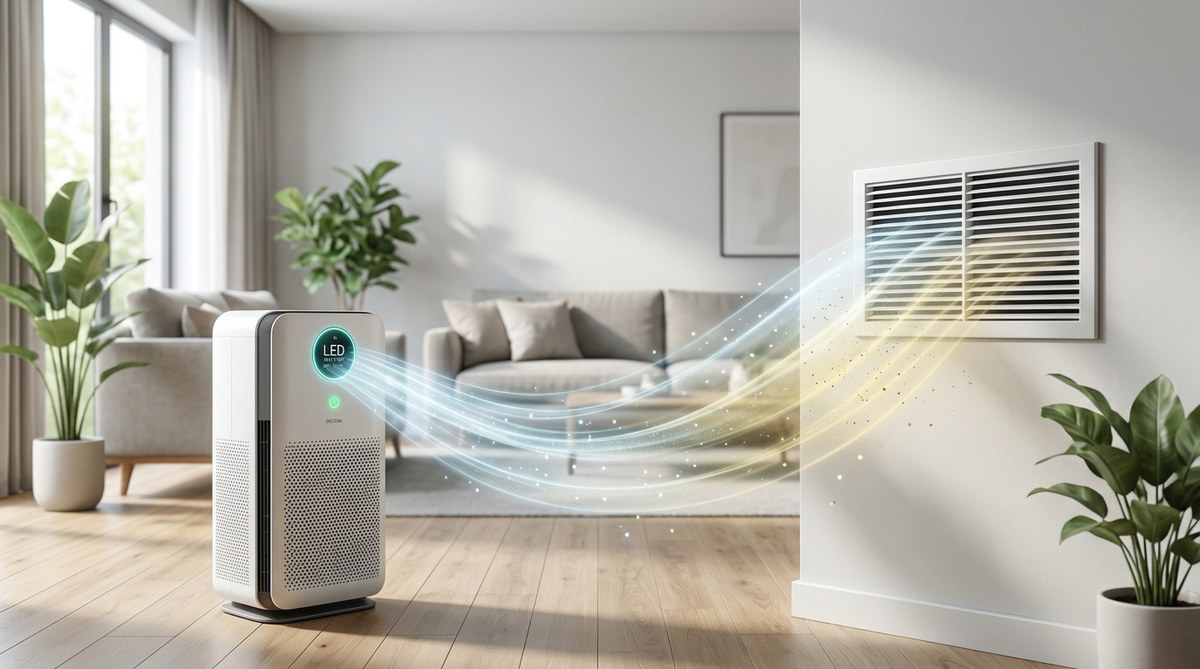
Your air purifier runs all day, but the air still feels stuffy. You check the filter, and it looks fine. You check the room size, and the purifier is rated for it. So what is going wrong?
The answer might be hiding in your walls. Your central HVAC system, the same one that keeps you cool in July and warm in January, has a huge impact on how well your air purifier works. In fact, it can either be your best friend or your biggest obstacle when it comes to cleaning the air you breathe.
Your HVAC system and air purifier share the same airspace, but they often work against each other. If your furnace or AC creates strong air currents, it can push dirty air past your purifier before the unit has time to clean it. The fix involves better placement, matching your HVAC filter to your purifier type, and sealing common air leaks around ducts and windows.
The Invisible Battle Between Your Furnace and Your Purifier
Think of your home as a single room with two fans. One fan (your HVAC) moves air through the whole house. The other fan (your purifier) tries to clean the air in one spot. When the HVAC fan runs, it creates turbulence. That turbulence can blow dust and pollen past the purifier so fast that the purifier never gets a chance to catch them.
This is especially true during seasonal changes. In the fall, when you fire up the furnace for the first time, it kicks up months of settled dust from the ducts. Your air purifier suddenly has to work much harder. If it is placed near a supply vent, it might actually pull in dirty air from the ductwork instead of cleaning the room air.
How to Make Them Work Together Instead of Against Each Other
You can fix this tension. It just takes a little planning. Here are three practical steps to align your HVAC system with your air purifier.
- Place your purifier away from HVAC vents. Do not put it directly under a supply register or next to a return grille. Give it at least three feet of clearance. This lets the purifier pull air from the room instead of competing with the forced air from the duct.
- Run your HVAC fan on low or auto when the purifier is on. High fan speeds create too much air movement. The purifier needs still air to be effective. If you can, set the thermostat fan to “auto” so it only runs when the system is actively heating or cooling.
- Upgrade your HVAC filter to a MERV 11 or 13. A better filter in your furnace or air handler catches more particles before they enter the room. This takes the load off your standalone purifier. Just check your system manual first. Some older units cannot handle the airflow restriction of a high-MERV filter.
A Simple Table to Compare HVAC and Purifier Strategies
Not all setups are the same. Use this table to match your situation with the right approach.
| Your Situation | Best Strategy | Common Mistake |
|---|---|---|
| Forced air furnace with central return | Place purifier in the living room, away from the return grille | Putting the purifier in the basement near the furnace |
| Ductless mini-split or window AC | Place purifier in the room where you spend the most time | Running the AC fan on high while the purifier is on |
| Older home with leaky ducts | Seal visible gaps with foil tape or mastic | Assuming the purifier can handle the extra dust load alone |
| Newer home with a fresh air intake | Check that the intake filter is clean and properly fitted | Forgetting to change the intake filter seasonally |
The Right Filter for Your HVAC System Matters More Than You Think
Most homeowners focus on the air purifier filter and forget about the HVAC filter. That is a missed opportunity. Your HVAC system pulls air from every room, runs it through a filter, and then sends it back out. If that filter is low quality, your entire house becomes a mixing bowl for dust, pet dander, and pollen.
A standard fiberglass filter (MERV 1 to 4) stops large debris but lets tiny particles pass through. Those tiny particles are exactly what your air purifier is trying to catch. By upgrading to a MERV 11 or 13 filter in your HVAC system, you remove more particles before they ever reach the room. Your air purifier then only has to handle the leftovers.
A good rule of thumb from HVAC pros: match your HVAC filter to your purifier’s pre-filter level. If your purifier has a washable pre-filter, a MERV 8 in the furnace is fine. If your purifier uses a true HEPA filter, upgrade the HVAC filter to MERV 11 or higher for the best results.
Common Mistakes That Ruin the Interaction
Even with good intentions, people often make errors that hurt performance. Here are the most common ones.
- Running the air purifier only when the HVAC is off. The purifier needs to run continuously to keep up with the particles the HVAC stirs up.
- Closing vents in unused rooms. This creates pressure imbalances that force dust out of other leaks in the ductwork.
- Using a HEPA purifier in a room with a window AC unit that pulls in outdoor air. The purifier cleans the room air, but the AC keeps bringing in new pollutants.
- Ignoring the HVAC filter change schedule. A clogged HVAC filter makes the blower work harder and can push unfiltered air around the filter edges.
How to Test If Your Setup Is Working
You do not need expensive equipment to check the interaction. Try this simple test.
- Turn on your HVAC system to a normal setting.
- Place a tissue on top of your air purifier. If the tissue moves or falls off, the airflow from the HVAC is too strong near the purifier.
- Move the purifier to a different spot and repeat the test until the tissue stays still.
That stable spot is where your purifier will work best. It means the HVAC airflow is not interfering with the purifier’s intake and output.
A Bulleted List of Setup Checks for Every Season
Use this checklist at the start of each new season.
- Check the HVAC filter and replace it if it looks dirty or has been in use for more than three months.
- Vacuum the area around your air purifier’s intake vents to remove settled dust.
- Verify that no furniture is blocking either the HVAC return vent or the purifier’s intake.
- Open all supply vents fully to avoid pressure imbalances.
- Run the purifier on its highest setting for the first 24 hours after the HVAC system kicks on for the season.
Why This Matters for Allergy and Asthma Sufferers
If you or someone in your home deals with allergies or asthma, the interaction between your HVAC and air purifier can make a real difference in daily comfort. When the two systems work against each other, you might still wake up stuffy or sneezy even though the purifier is running. When they work together, the air feels noticeably cleaner.
For more targeted advice, check out our guide on top air purifiers for allergies and asthma relief in 2026. It covers specific models that handle the extra load from HVAC systems well.
The One Upgrade That Changes Everything
If you only do one thing after reading this, upgrade your HVAC filter to a MERV 11. It is a small investment that pays off every day. Your air purifier will run more efficiently, your HVAC system will stay cleaner inside, and you will breathe better air throughout the whole house. Just make sure your system is compatible. Most modern furnaces and air handlers handle MERV 11 without issue, but check the manual or ask an HVAC tech.
Putting It All Together for a Healthier Home
Your HVAC system and your air purifier do not have to be rivals. With a few adjustments to placement, filter quality, and seasonal habits, they can become a powerful team. Start with the tissue test to find the right spot for your purifier. Then upgrade your HVAC filter to match your needs. Finally, run both systems with intention instead of on autopilot.
Your home will feel fresher, your allergies might calm down, and your energy bills could even drop because both systems are running at their best. For more ways to create a healthier living space, take a look at our top strategies to improve indoor air quality and create a healthier living environment. The air you breathe is worth the effort.