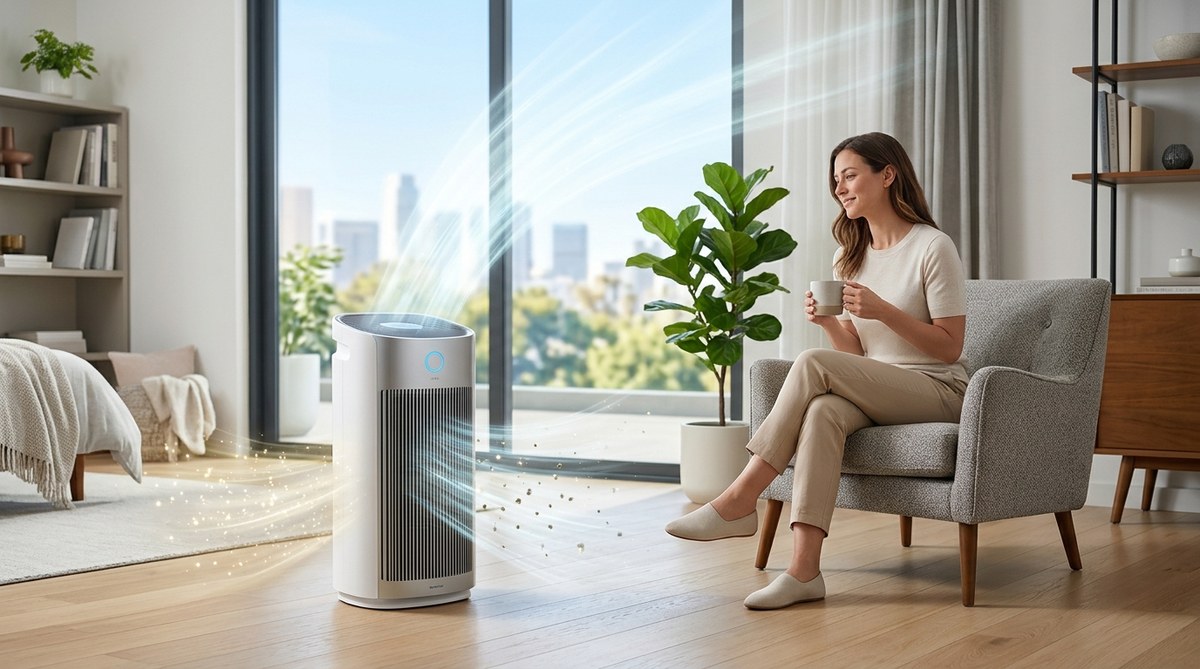
You have the air purifier sitting in the corner of your living room. It hums along day and night, and you trust it is doing its job. But here is the hard truth: if you bought that machine without checking its CADR rating, it might be working far below its potential. CADR stands for Clean Air Delivery Rate, and it is the single most useful number on the box. It tells you exactly how much filtered air the unit pushes into a room. Ignore it, and you could end up with a device that barely makes a dent in your indoor air quality. Pay attention to it, and you will finally get the clean, fresh air your family deserves.
CADR rating is not just a number on a spec sheet. It is the best predictor of how well an air purifier will clean a specific room. To get real results, match the CADR to your room size, consider your biggest pollutants, and run the unit on the right fan speed. A higher CADR means faster cleaning, fewer allergens, and better breathing for you and your family.
What CADR Actually Measures
CADR is measured in cubic feet per minute (CFM). The number tells you the volume of air that passes through the filter and comes out clean every minute. The test is standardized by the Association of Home Appliance Manufacturers (AHAM), so you can compare models fairly.
There are three separate CADR ratings for most purifiers:
- Smoke CADR – how well the unit removes fine smoke particles
- Dust CADR – how well it handles larger dust particles
- Pollen CADR – how well it captures pollen and other large allergens
The smoke CADR is usually the most important because smoke particles are the smallest and hardest to trap. If a purifier has a high smoke CADR, it will handle dust and pollen even better. When you compare models, look at the smoke CADR first. That single number will tell you the most about the machine’s real power.
Why Room Size Changes Everything
You can own the most expensive air purifier on the market, but if it is too small for your room, it will never keep up. The general rule is simple: your purifier should have a CADR that is at least two-thirds of your room’s square footage. For example, a 300-square-foot living room needs a smoke CADR of at least 200 CFM.
Let us break that down into a practical process you can use right now.
- Measure the length and width of the room in feet. Multiply them to get the square footage.
- Multiply that number by 0.67. That gives you the minimum smoke CADR you need.
- Look for a purifier with a smoke CADR at or above that number.
- If you have high ceilings (over 8 feet), add 25 percent to your room size before calculating.
- Choose a model with a CADR that exceeds the minimum if you have pets, smokers, or seasonal allergies.
This method works for any room in your home. A bedroom that is 150 square feet needs a CADR of at least 100. An open-concept kitchen and living area of 500 square feet needs at least 335. Do the math before you buy, and you will never waste money on an underpowered machine.
The CADR and Fan Speed Connection
Here is a detail most people miss: the CADR rating is measured at the highest fan speed. When you run your purifier on low or medium, the actual CADR drops. That means the machine cleans the air more slowly.
If you want the full benefit of the rated CADR, run the unit on high when air quality is poor. For everyday maintenance, a lower speed is fine as long as you give the unit extra time. Just understand that on low speed, your purifier might need two or three times longer to cycle the room air.
“A purifier running on low speed may only deliver half its rated CADR. That is the difference between cleaning a room four times per hour and only twice. For allergy sufferers, those two extra air changes matter a lot.” – Indoor air quality specialist
Common CADR Mistakes and How to Fix Them
Many homeowners pick a purifier based on looks or brand name. They end up with a machine that looks great but underperforms. Below is a table of the most frequent mistakes and the simple fixes.
| Mistake | Why It Hurts You | The Fix |
|---|---|---|
| Buying a unit with CADR too low for the room | Air never gets fully clean, allergens linger | Use the two-thirds rule to match CADR to square footage |
| Ignoring the smoke CADR and only looking at dust | Smoke CADR is the hardest test; if it is low, the unit is weak overall | Always compare smoke CADR numbers first |
| Running the purifier only on low speed | Effective CADR drops by half or more | Use high speed during peak pollution (cooking, wildfire smoke, cleaning) |
| Placing the unit behind furniture | Airflow is blocked, CADR becomes meaningless | Put the purifier in an open spot with at least 2 feet of clearance on all sides |
| Forgetting to replace filters | Dirty filters restrict airflow and reduce CADR drastically | Follow the manufacturer’s schedule; check filters every 3 to 6 months |
If you want to get the most out of your purifier, avoid these five errors. The fix for each one is straightforward and will save you frustration.
How to Read a CADR Label Like a Pro
When you pick up a box at the store or scroll through listings online, the CADR rating is usually printed clearly. Sometimes it is buried in the product manual. Here is what to look for.
- Look for the AHAM seal. That means the CADR was tested by an independent third party.
- Find the smoke CADR number. That is your benchmark.
- Check the suggested room size. Some brands list a range like “up to 400 sq ft.” Be skeptical. The actual CADR might only support a room half that size for effective cleaning.
A good rule of thumb: if the suggested room size seems too good to be true, do the math yourself. Divide the smoke CADR by 0.67. That gives you the real maximum room size for that purifier. A unit with a smoke CADR of 200 is good for about 300 square feet. A unit with a smoke CADR of 100 is only good for about 150 square feet.
For a deeper look at how to match a purifier to your home’s unique needs, check out our guide on how to match your air purifier to your home’s unique pollutant profile. It covers everything from pet dander to wildfire smoke.
When Higher CADR Is Not the Answer
More power is not always better. A purifier with a very high CADR in a small room can create uncomfortable drafts. It will also use more electricity and may be louder than necessary.
For a small bedroom or office under 150 square feet, a CADR of 100 to 150 is plenty. Going higher than that can make the room feel like a wind tunnel. Instead, focus on a unit that matches the room size and runs quietly on its lower speeds. That gives you the best balance of clean air and comfort.
If you are dealing with specific issues like mold spores or excess humidity, a dehumidifier might be a better first step. Read our guide on top tips for choosing the best dehumidifier for your home to see how it works alongside an air purifier.
Putting CADR to Work in Your Home
Now that you understand the numbers, it is time to apply them. Here is a simple checklist to use when you shop for your next air purifier or evaluate the one you already own.
- Measure the room. Write down the square footage.
- Calculate the minimum smoke CADR (room sq ft x 0.67).
- Check your current purifier’s smoke CADR. Is it high enough?
- If it is too low, consider moving that unit to a smaller room and buying a larger one for the main space.
- Run the purifier on high for 30 minutes after cooking, vacuuming, or when outdoor air quality is poor.
- Replace filters on time. A clogged filter cuts CADR by up to 40 percent.
For more hands-on advice, take a look at our article on how to maximize air purifier effectiveness for a healthier home in 2026. It covers placement, scheduling, and maintenance tips that work with any CADR rating.
The Real Cost of Ignoring CADR
You might save a few dollars buying a lower-rated unit. But the hidden cost comes in the form of lingering allergens, dust, and pollutants. If you or someone in your home suffers from allergies or asthma, an underpowered purifier means more symptoms and less relief. Over a year, that translates into more sick days, poorer sleep, and higher medical costs.
Think of CADR as the engine horsepower of your air purifier. You would not buy a car with a tiny engine and expect it to haul a heavy load. The same logic applies to cleaning the air in your home. Spend the extra money on a unit with a CADR that matches your room. Your lungs will thank you.
Living with the Right CADR
Once you have the right purifier in place, you will notice the difference within days. The air feels lighter. Dust settles less quickly. Your nose and throat feel less irritated. That is the CADR working as intended.
Make it a habit to check the CADR before any future purchase. Whether you are buying for a nursery, a home office, or a large family room, the math stays the same. It is the one number that cuts through the marketing hype and tells you what a machine can actually do.
If you are ready to find the best models for your home, browse our list of top air purifiers for allergies and asthma relief in 2026. Each recommendation includes its CADR rating so you can compare at a glance.
Start Breathing Cleaner Air Today
You now have the knowledge to pick the right air purifier for every room. Grab a tape measure, do the quick calculation, and match your next purchase to the CADR number that fits your space. That small step will transform how well your purifier performs. No guesswork, no wasted money, just cleaner air that you can actually feel. Go ahead and check your current unit right now. If the CADR does not match your room, you know what to do next.