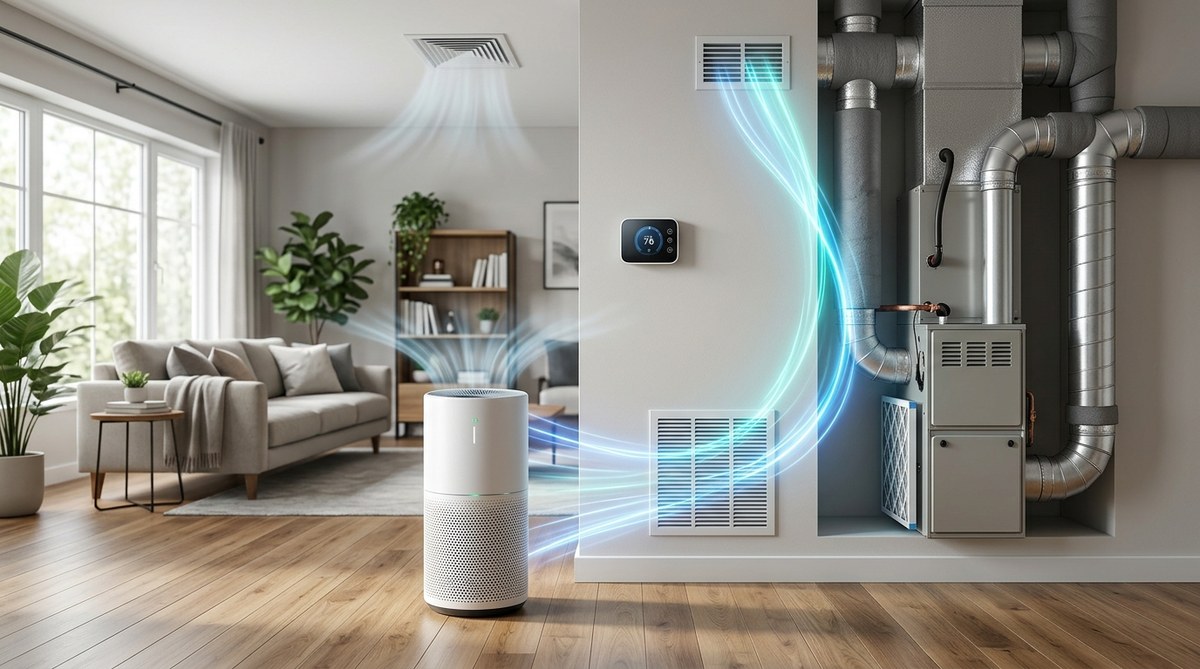
Your air purifier and your HVAC system are not independent appliances. They share the same air. They influence each other’s performance every single day. Understanding this relationship is the key to breathing better indoors without wasting money on energy bills or buying equipment that fights against itself.
A portable air purifier and a central HVAC system can either work together or against each other. Your HVAC moves air through the whole house, while a purifier cleans a single room. If you place the purifier near a return vent, it will pull dirty air from the entire home. If you place it near a supply vent, it may recirculate already filtered air. The goal is to create a complementary system that maximizes filtration without straining your heating or cooling equipment.
How Your HVAC System Moves Air Through Your Home
Your central heating and cooling system works like a lung. It pulls air from rooms through return ducts, conditions it, and pushes it back through supply vents. This cycle happens constantly when the fan is running. The filter inside your HVAC unit catches large particles like dust and pet hair, but most standard HVAC filters are not designed to capture microscopic pollutants like pollen, mold spores, or fine smoke particles.
That is where your air purifier comes in. A portable unit with a true HEPA filter can trap particles as small as 0.3 microns. But here is the catch. If you place that purifier in a room without considering how the HVAC moves air, you might be cleaning the wrong air or creating a short circuit that wastes electricity.
The Hidden Conflict Between Your Purifier and Your HVAC
Many homeowners assume that running an air purifier in the same room as a supply vent will clean the air faster. In reality, it can create a problem called “short cycling.” The purifier pulls in air, cleans it, and then the HVAC supply vent blows that clean air right back toward the purifier intake. The purifier ends up cleaning the same small pocket of air while the rest of the room stays dirty.
This hidden issue wastes energy and reduces the effectiveness of both systems. A 2026 study from the National Renewable Energy Laboratory found that homes with poorly placed portable purifiers saw a 12 to 18 percent increase in HVAC runtime because the thermostat misread the localized temperature near the purifier.
How to Spot Short Cycling in Your Home
Look for these signs:
– A room feels stuffy even though the purifier has been running for hours
– The purifier fan sounds like it is working hard but the air quality sensor shows little improvement
– Your HVAC system cycles on and off more frequently than usual
– The temperature near the purifier feels different than the rest of the room
The Right Way to Integrate a Portable Air Purifier with Your HVAC
Getting these two systems to cooperate is simpler than you might think. Follow these steps to create a setup that works with your HVAC instead of against it.
-
Place the purifier away from supply vents. Keep at least four to six feet of distance between the purifier and any vent that blows conditioned air into the room. This prevents the purifier from re-cleaning the same air.
-
Position the purifier near a return air grille if possible. Return vents pull air out of the room and back into the HVAC system. Placing a purifier nearby means it will clean the air before it gets recirculated through the whole house. This is one of the most effective strategies for whole-home air quality improvement.
-
Run the HVAC fan on “On” mode instead of “Auto.” When the fan runs continuously, it keeps air moving throughout the house. This gives the purifier a steady stream of air to clean. Running the fan on Auto means it only moves air when heating or cooling is needed, which leaves the purifier working in a stagnant room for long periods.
-
Check your HVAC filter regularly. A dirty HVAC filter forces your system to work harder and reduces airflow. This makes it harder for your purifier to pull in air from other rooms. Replace standard 1-inch filters every 90 days. For pleated filters, follow the manufacturer’s recommendation.
-
Use a purifier sized for the room. A unit that is too small will struggle to keep up, especially when the HVAC is pushing air from other rooms into the space. Use the Clean Air Delivery Rate (CADR) to match the purifier to your room size. For a 300 square foot room, look for a CADR of at least 200 for smoke, dust, and pollen.
What Happens When You Ignore the Integration
If you ignore how these systems interact, you can end up with some frustrating outcomes. The table below breaks down the most common mistakes and their real world consequences.
| Mistake | What Happens | Energy Impact | Air Quality Impact |
|---|---|---|---|
| Purifier near supply vent | Short cycling, re-cleaning same air | HVAC runs 10-15% longer | Little improvement in room |
| Purifier in a closed room with door shut | No fresh air exchange, purifier works alone | No HVAC impact in that room | High local filtration, poor whole home |
| Purifier too small for room with open floor plan | Cannot keep up with air volume | HVAC may overcompensate | Uneven air quality |
| Running purifier on high while HVAC fan is off | Creates localized pressure difference | Wastes electricity | Minimal whole home benefit |
| Ignoring HVAC filter replacement | Reduced airflow through ducts | 15-20% higher energy use | Purifier works harder to compensate |
The Surprising Energy Efficiency Upside
When you integrate an air purifier correctly, it can actually help your HVAC system run more efficiently. Cleaner air means less dust buildup on your evaporator and condenser coils. Less dust means better heat transfer. Better heat transfer means your system does not have to run as long to reach the set temperature.
A well placed purifier also reduces the load on your HVAC filter. Standard 1-inch filters clog faster when the air is full of particles. When your purifier catches those particles first, the HVAC filter stays cleaner longer. That means lower static pressure in the ducts and less strain on the blower motor.
“Most homeowners do not realize that the single biggest energy waste in a forced air system is a dirty filter. A portable air purifier with a pre-filter can extend the life of your HVAC filter by up to 40 percent, which directly lowers your monthly utility bill.” – Mark T., HVAC technician with 22 years of experience in the Midwest
When Whole-Home Integration Makes Sense
For homeowners who are serious about air quality, there is a better option than trying to coordinate multiple portable units. Whole-home air purification systems integrate directly into the HVAC ductwork. These systems use a high efficiency filter, often a HEPA or a media filter with a MERV 13 rating or higher, installed in the main return duct.
The benefits of a ducted system are clear:
– One filter cleans air for the entire house
– No short cycling because the air passes through the filter before distribution
– No floor space taken up by portable units
– Less noise because the filter is in the basement or utility room
The tradeoff is cost and installation complexity. A whole-home system requires a professional HVAC contractor to modify the ductwork. The upfront cost is typically $1,500 to $3,500, depending on the size of your home and the filter type. Portable units cost less upfront but require more maintenance and coordination.
For a detailed comparison of different filter types, read our guide on what air purifiers actually remove.
The Maintenance Schedule That Keeps Both Systems Happy
Both your portable purifier and your HVAC system need regular attention. Here is a simple schedule to follow.
- Every 30 days: Check the pre-filter on your portable purifier. Vacuum or wash it if it is reusable. Replace if it is disposable.
- Every 90 days: Replace your standard 1-inch HVAC filter. If you use a higher MERV rated filter, check it monthly because it traps more particles and clogs faster.
- Every 6 months: Deep clean the exterior and intake vents of your portable purifier. Dust buildup on the intake grille reduces airflow by up to 30 percent.
- Every 12 months: Have your HVAC system professionally inspected. Ask the technician to check the evaporator coil for dust accumulation. If you run a purifier, the coil should be cleaner than average.
If you want to save money on replacement filters, check out our guide on how to extend the life of your air purifier’s filters.
Common Mistakes That Ruin the Relationship
Even well intentioned homeowners make errors that reduce the effectiveness of both systems. Here are the most frequent ones.
- Putting the purifier in a corner behind furniture. Air needs to flow freely around the unit. A clearance of at least 12 inches on all sides is necessary for proper intake and output.
- Running the purifier only when someone is in the room. Air quality degrades quickly when the purifier is off. Running it 24/7 on a low setting is more effective and uses less energy than running it on high for short bursts.
- Using an ozone generating purifier in a home with forced air heating. Ozone can react with duct materials and create byproducts that irritate the lungs. Stick with HEPA or activated carbon filters for HVAC integration.
- Closing bedroom doors while the purifier runs. The purifier needs air exchange to work. If the door is shut, it will clean the bedroom air but will not help the rest of the house. Leave doors open or use a transfer grille.
For more on placement mistakes, read our article on the best air purifier placement for maximum efficiency.
How to Test If Your Integration Is Working
You do not need expensive equipment to check if your purifier and HVAC are working together. Try this simple test.
Turn on your HVAC system so the fan is running. Place your portable purifier in the recommended position away from supply vents. Let both run for 30 minutes. Then, walk through the house and pay attention to how the air feels. If the air in the room with the purifier feels noticeably cleaner than the air in the hallway, the purifier is not helping the rest of the house. If the air feels consistent from room to room, your integration is working.
For a more precise measurement, use a portable air quality monitor. Place it in a room far from the purifier. Check the PM2.5 reading before and after running both systems. A drop of 50 percent or more indicates good integration.
The Link Between Air Purifiers and Humidity Control
Your HVAC system also manages humidity. When you run an air purifier, especially one with a carbon filter or a UV-C light, it can slightly warm the air passing through it. This small temperature change can affect how your thermostat reads the room. In humid climates, this can cause the HVAC to run longer than necessary to remove moisture.
If you live in a humid area like the Southeast, consider using a dehumidifier alongside your purifier. Our guide on understanding dehumidifier settings can help you find the right balance.
Matching Your Purifier to Your Home’s Pollutant Profile
Not all homes need the same type of filtration. Your HVAC system moves air differently depending on the season, the construction of your home, and your lifestyle. Here is how to match your purifier to your specific situation.
- Homes with pets: Use a purifier with a washable pre-filter to capture pet hair before it reaches the HEPA filter. Place the purifier in the room where your pets spend the most time.
- Homes with smokers or frequent cooking: Add a heavy duty activated carbon filter to capture odors and VOCs. The HVAC system will recirculate these odors if the purifier does not capture them first.
- Homes in wildfire prone areas: Use a purifier with a high CADR for smoke particles. Run the HVAC on recirculate mode and place the purifier near the return vent to filter smoke before it spreads.
- Homes with allergies: Focus on a true HEPA filter. Place the purifier in the bedroom and run it 24/7 during allergy season.
For a deeper look at matching your purifier to your home, read our guide on how to match your air purifier to your home’s unique pollutant profile.
A Final Look at the Big Picture
Your HVAC system is the circulatory system of your home. Your air purifier is a specialized organ that filters the blood. When they work together, the whole house benefits. When they work against each other, you waste money and breathe air that is not as clean as it could be.
The hidden link between your air purifier and your HVAC system is not a mystery. It is a simple relationship based on airflow, placement, and maintenance. Pay attention to where you put your purifier. Keep both filters clean. Run the HVAC fan consistently. That is all it takes to turn two separate appliances into a single, effective air cleaning system.
Put This Knowledge to Work Today
Start by checking the placement of your air purifier right now. Is it near a supply vent? Move it. Is your HVAC filter overdue for a change? Replace it. These two small actions will immediately improve how your home feels and how much you spend on energy.
If you are shopping for a new purifier, keep HVAC integration in mind. Look for a unit with a high CADR and a pre-filter. Consider a whole-home system if you are planning a major renovation. And always remember that the best air purifier is the one that works with your home’s existing systems, not against them.
For more help choosing the right purifier for your home, check out our recommendations for the best air purifiers to create a healthier indoor environment.