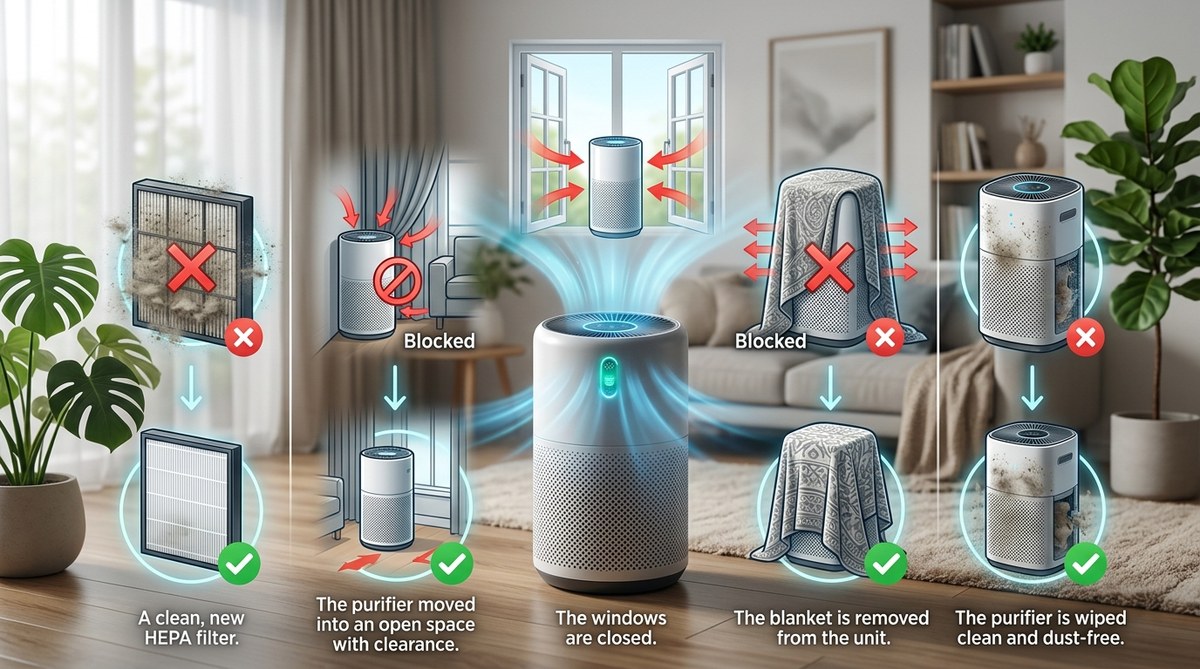
You spent good money on an air purifier. You set it up. You turned it on. And now you are wondering why your allergies still flare up, why dust still settles on your nightstand, or why that faint musty smell just won't leave. You are not alone. Most people make at least one of these air purifier mistakes without knowing it. The good news is that every single one is easy to fix. You do not need a new machine. You just need to adjust how you use the one you already own.

<div style="border:1px solid #c8b88a; background:#fbf7ea; padding:20px; border-radius:14px; margin-bottom:30px;">
  <div style="font-weight:700; margin-bottom:10px; color:#856404;">Key Takeaway</div>
  <p style="margin:0;">Many homeowners unknowingly sabotage their air purifier's performance with simple, fixable errors. Placing the unit in a corner blocks airflow and reduces circulation. Running it only on low or just when odors appear limits how much air gets cleaned. Forgetting to clean the pre-filter forces the HEPA filter to clog faster. Choosing a size based only on floor space ignores ceiling height and room volume. These five fixes can double your purifier's output without spending a dime on a new machine.</p>
</div>

## The Corner Trap: Why Your Purifier Needs Room to Breathe

You probably set your air purifier in a corner to keep it out of the way. Maybe you tucked it behind a couch or next to a bookshelf. That move is one of the most common air purifier mistakes, and it cuts your machine's effectiveness by more than half.

Air purifiers work by pulling dirty air in from one side and pushing clean air out from another. If you block either side, you choke the machine. A corner location means the intake faces a wall. The wall creates a dead zone where air cannot move freely. Instead of pulling air from the whole room, the purifier only cycles a tiny pocket of air near the floor.

Here is what happens in practice. You run the unit for eight hours, but most of the dust and pollen in the center of the room never gets pulled in. The purifier works hard but moves very little volume.

The fix is simple. Place your purifier at least 12 to 18 inches away from any wall or furniture. Put it near the center of the room if you can. If that is not possible, put it along a wall but leave space on all sides. The intake needs clear access to the room air.

> **Expert advice from certified indoor air quality specialist Mark R.:** "I see this in nearly every home visit. People treat their air purifier like a decorative lamp. They hide it. But a purifier hidden in a corner is a paperweight. Give it three feet of clearance on the intake side and watch your particle counts drop."

## Running on Low All Day Sounds Smart but It Is Not

Many owners set their purifier to the lowest fan speed and leave it there. They want peace and quiet. They want to save electricity. These are reasonable goals, but they come with a hidden cost.

Low speed moves very little air. A typical purifier on low might cycle the room air once every four hours. On high, it might cycle the same room four times per hour. That is a 16x difference in cleaning power.

You do not need to run high all day. But you should use auto mode if your unit has one. Auto mode senses the air quality and ramps up when it detects particles. If your purifier lacks auto mode, run it on medium during the day and high when you leave the house or sleep.

Here is a practical approach to fan speeds:

1. **Morning and evening** when you are home and active, run on medium. This keeps air moving during high-activity times when you stir up dust.
2. **While you sleep**, run on low if noise bothers you, but consider medium if you have allergies. Many modern purifiers have a sleep mode that balances noise and performance.
3. **When you are away**, run on high. Nobody is there to hear it, and this gives the unit a chance to fully scrub the room.
4. **After cooking or cleaning**, run on high for at least 30 minutes. These activities release a burst of particles that low speed cannot handle.

This is one of those air purifier mistakes that feels smart but actually wastes your investment. Running low all day uses power but delivers poor results. A few hours on high does more work than 24 hours on low.

## The Filter Trap: You Change the Big Filter but Ignore the Small One

Your air purifier has more than one filter. Most units have a pre-filter and a main HEPA filter. The pre-filter catches large particles like pet hair, dust bunnies, and lint. The HEPA filter catches tiny particles like pollen, mold spores, and smoke.

Here is the mistake. People replace the HEPA filter on schedule but never touch the pre-filter. They do not even know it exists. The pre-filter gets caked with debris. Air cannot pass through it. The HEPA filter still looks clean, but the machine moves almost no air because the pre-filter is clogged.

Symptoms of a clogged pre-filter:

- The purifier sounds quieter than usual (because less air is moving).
- You see visible dust buildup on the intake grille.
- The air feels stagnant even after hours of running.
- The filter replacement indicator lights up faster than expected.

You can avoid this with a 30-second habit. Once a month, pull out the pre-filter and vacuum it with a brush attachment. If it is washable, rinse it under cool water and let it dry completely before putting it back. A clean pre-filter takes pressure off the HEPA filter and extends its life by months.

This is one of those air purifier mistakes that costs you money. A clogged pre-filter forces the HEPA filter to work harder, so you have to replace it sooner. HEPA filters are expensive. A little pre-filter maintenance saves you real cash.

| Mistake | What Happens | How to Fix It |
|---------|-------------|---------------|
| Placing unit in a corner | Airflow drops by half | Move it 12-18 inches from walls |
| Running only on low | Room air cycles too slowly | Use auto mode or run high when away |
| Ignoring the pre-filter | Main filter clogs fast | Vacuum or wash pre-filter monthly |
| Sealing windows completely | CO2 builds up indoors | Open windows 5-10 minutes daily |
| Buying too small for the room | Unit runs constantly with poor results | Match CADR to room volume, not just floor area |

## Fresh Air Still Matters: The Window Balance

Some owners seal every window and door tight, thinking this helps the purifier do its job. They want to keep outdoor pollution out. That makes sense. But there is a catch.

Your body produces carbon dioxide every time you breathe. In a sealed room, CO2 levels rise. After a few hours, you might feel drowsy, get a headache, or have trouble concentrating. This is not the purifier's fault. It simply cannot create oxygen or remove CO2.

The fix is a short daily air exchange. Open two windows on opposite sides of the room for five to ten minutes. This flushes out stale air and brings in fresh oxygen. Then close everything and let the purifier do its work. You get the best of both worlds: low outdoor pollution during the day and fresh oxygen when you need it.

This is especially important during allergy season. You might think sealing everything helps your allergies. But if you never air out the room, you are breathing recycled CO2 all night. Your sleep quality suffers. A quick morning air flush solves this.

## Size Matters More Than You Think

You bought a purifier rated for a 500-square-foot room. Your living room is 400 square feet. You are covered, right? Not necessarily.

Most brands measure room size based on a standard 8-foot ceiling. If your ceilings are 10 or 12 feet, the air volume is much larger. A 400-square-foot room with 10-foot ceilings has 4,000 cubic feet of air. That same room with 8-foot ceilings has 3,200 cubic feet. The purifier has to clean 25% more air than its rating assumes.

Here is how to calculate what you actually need:

1. Measure the room's length and width in feet.
2. Multiply them to get square footage.
3. Multiply that by the ceiling height in feet to get cubic feet.
4. Divide by 8 to get the adjusted square footage for an 8-foot ceiling baseline.
5. Match this adjusted number to the purifier's rated room size.

For example, a 15x15 room with 10-foot ceilings has 2,250 cubic feet. Divide by 8 gives you 281 adjusted square feet. You need a purifier rated for at least 300 square feet, not the 225 square feet that floor area alone suggests.

This is one of those air purifier mistakes that frustrates people the most. They buy what looks like the right size, run it constantly, and still see dust on their furniture. The unit is working hard but cannot keep up with the actual air volume.

If you already own a purifier that is too small, you are not stuck. You can move it to a smaller room where it will be effective. Then save up for a larger unit for the big space. A purifier that is undersized for a living room might be perfect for a bedroom or home office.

## Putting It All Together for Cleaner Air

Avoiding these air purifier mistakes does not require any special skills. You just need awareness. Give your purifier space to breathe. Use the right fan speed for each part of your day. Clean the pre-filter every month. Let fresh air in for a few minutes each morning. Make sure your unit's size matches the actual volume of your room.

Small changes make a big difference. Someone who fixes all five of these issues can see a noticeable improvement in indoor air quality within a week. Allergy symptoms ease up. Dust settles less often. The air feels fresher even before you walk through the door.

If you are still shopping for a purifier or thinking about upgrading, take these lessons with you. Look for a unit with a cleanable pre-filter, an auto mode, and a CADR rating that matches your room's cubic footage. The right machine combined with smart habits will keep your indoor air healthy all year.

Your air purifier is a tool. Like any tool, it works best when you use it correctly. Start with these fixes today. Your lungs will thank you.