<|output_start|>
You turn on your air purifier, expecting a fresh breeze. Instead, you get a weak hum, a strange smell, or nothing at all. It's frustrating, especially when you rely on it for allergy relief or dust control. The good news? Most of the time, the fix is simpler than you think. Let's walk through the common reasons your air purifier not working and how to solve each one.

<div style="border:1px solid #c8b88a; background:#fbf7ea; padding:20px; border-radius:14px; margin-bottom:30px;">
  <div style="font-weight:700; margin-bottom:10px; color:#856404;">Key Takeaway</div>
  <p style="margin:0;">If your air purifier seems to be underperforming or has stopped working entirely, you're not alone. Many owners face issues like reduced airflow, strange noises, or failure to power on. Often, the cause is a clogged filter, improper placement, or incorrect settings. This guide covers seven common problems and step-by-step fixes to restore your air purifier's performance quickly. Save money on replacements by troubleshooting before calling a repair service.</p>
</div>

## Why Your Air Purifier Might Be Underperforming

Before you assume the unit is broken, know that nine out of ten performance complaints come from simple user errors or maintenance gaps. Below are the most common culprits, starting with the biggest offender.

### 1. The Filter Is Clogged or Past Its Prime

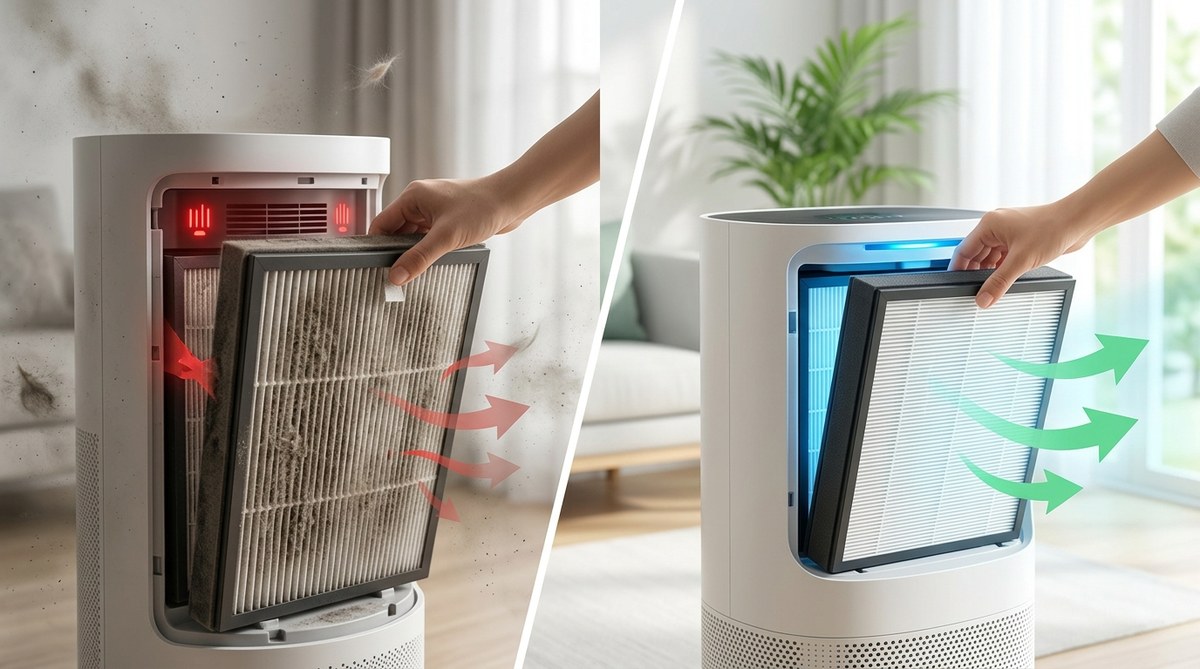
A dirty filter is the #1 reason an air purifier not working as expected. Over time, filters trap particles until they become saturated. When that happens, airflow drops dramatically, and the motor works harder without cleaning the air.

Signs of a clogged filter:

- Weak or barely noticeable airflow from the vent
- The unit makes a louder whirring or straining noise
- A musty or dusty smell when running
- The filter indicator light is red or blinking (if your model has one)

**How to fix it:** Check your owner's manual for the recommended replacement schedule. Most HEPA filters need swapping every 6 to 12 months. Pre-filters (washable foam or mesh) should be cleaned every 2 to 4 weeks. Vacuum the exterior vents while you're at it.

| Filter Type | Typical Lifespan | Care Needed |
|-------------|------------------|-------------|
| True HEPA | 6-12 months | Replace; never wash |
| Washable pre-filter | 1-3 months | Rinse with water, dry completely |
| Carbon/charcoal pre-filter | 3-6 months | Replace or vacuum |
| Hybrid HEPA+carbon | 6-12 months | Replace entire assembly |

If your filter is old, grab a replacement. For guidance on picking the right one, see our [top tips for choosing the right air purifier to reduce allergens and pollutants](https://airfuji.com/top-tips-for-choosing-the-right-air-purifier-to-reduce-allergens-and-pollutants/).

### 2. It's Too Small for the Room

You might own a perfectly good purifier that simply can't keep up. Every unit has a recommended room size, usually measured in square feet. If you placed a small bedroom purifier in a 500-square-foot living room, it will run continuously without noticeable improvement.

**What to do:** Check the unit's CADR (Clean Air Delivery Rate) rating. A CADR of 200 or higher is better for medium to large rooms. Measure your room's square footage and compare it to the unit's maximum coverage. For open floor plans, you may need a second machine.

Interested in sizing it right? Read our [7 key features to look for in an air purifier in 2026](https://airfuji.com/7-key-features-to-look-for-in-an-air-purifier-in-2026/) before your next purchase.

### 3. Poor Placement Blocks Airflow

An air purifier needs breathing room. If you tuck it behind a curtain, shove it into a corner, or place it directly under a shelf, the intake and outlet vents get blocked. This starves the machine of air and stops it from circulating clean air around the room.

**Simple fix:** Move the unit at least 12 to 18 inches away from walls and furniture. Place it in an open area, preferably near the center of the space or where air circulates naturally (like near a doorway). Avoid putting it next to electronics that generate heat, as that can throw off sensors.

> "Most air purifier issues are due to neglected maintenance. A simple filter change can restore 90% of lost performance. Placement is the second thing we check." -- Frank, HVAC technician with 20 years of experience

### 4. Fan Speed Is Set Too Low

Many people set their purifier to the lowest fan speed to reduce noise, especially at night. While that's fine for maintaining clean air, it won't make a dent if the room has high pollution levels from cooking, pets, or pollen.

**How to adjust:** Run the unit on high or turbo mode for at least 30 minutes after a known pollutant event (like frying bacon or vacuuming). Use the auto mode (if available) so the sensor adjusts the fan speed based on real-time air quality.

### 5. Power or Connection Issues

Sometimes the problem isn't the unit itself. A loose power cord, a tripped circuit breaker, or a faulty outlet can make an air purifier not working at all. The display may be blank, or the fan might run intermittently.

**Diagnose with this checklist:**

1. Plug the purifier into a different wall outlet (preferably one you know works).
2. Check for a tripped breaker or GFCI outlet that needs resetting.
3. Inspect the power cord for frayed spots or chew marks if you have pets.
4. Remove the filter compartment cover and check that safety switches are fully engaged (some models won't power on without the filter door closed).
5. Test the outlet with another appliance.

If the unit still won't turn on, the internal power supply may be damaged. At that point, it's time to contact the manufacturer.

### 6. Settings Are Misconfigured

Modern purifiers come with timers, sleep modes, and ionizer settings. It's easy to accidentally set a timer that turns the unit off after an hour, or enable a sleep mode that reduces fan speed dramatically.

**What to check:**

- Timer setting: make sure it's not set to a short run time.
- Sleep mode: if you want full power, turn sleep mode off.
- Ionizer or UV light: these features use extra power but don't improve airflow. If your unit seems sluggish, turn them off temporarily.
- Child lock: some units have a lock that disables controls. Consult your manual to unlock.

### 7. The Unit Needs a Reset

Electronic controls can freeze or glitch. If your air purifier is not working despite all the above checks, try a full reset.

**How to reset most models:** Unplug the unit for a full 60 seconds. Press and hold the power button for 10 seconds to discharge any residual charge. Plug it back in and power on. This clears minor firmware errors.

If your model has a dedicated reset button (often labeled with a small hole for a paperclip), use that. Check your manual for model-specific steps.

## A Step-by-Step Troubleshooting Process

When you notice your air purifier not working, follow this numbered sequence to diagnose efficiently:

1. **Visual inspection** -- Look for blockages, dirty filters, and obvious damage.
2. **Filter check** -- Remove the filter and hold it up to a light. If you can't see through it, replace it.
3. **Power test** -- Plug into a different outlet and listen for the fan.
4. **Settings review** -- Go through every button and menu setting.
5. **Placement audit** -- Move the unit to a more open location.
6. **Reset** -- Unplug and wait, then restart.
7. **Contact support** -- If none of these work, note the model number and error codes for customer service.

## Common Fixes at a Glance

Use this table to match your symptom to the solution:

| Symptom | Likely Cause | Quick Fix |
|---------|--------------|-----------|
| No power, no lights | Loose cord, tripped breaker, blown fuse | Check outlet, reset breaker |
| Weak airflow | Clogged filter, low fan speed | Replace filter, raise fan speed |
| Loud or rattling noise | Loose debris, worn fan bearing | Remove obstructions, tighten screws |
| Strange smell | Dirty filter, mold inside filter | Replace filter, dry the unit |
| Runs but air feels unchanged | Room too large, open windows | Close doors/windows, reduce room size |
| Indicator light flashing | Filter needs replacement soon | Order a new filter |

## When to Replace vs. Repair

If your air purifier not working after all these fixes, it may be time for a replacement. Consider repair only if the unit is still under warranty or if the issue is minor (like a broken fan blade). For units older than 5 years, replacement is usually more cost-effective than paying for a repair technician.

Newer models in 2026 come with improved sensors, quieter motors, and better filtration. If you're in the market, look for units with a CADR that matches your room and features like real-time air quality feedback. Check out our guide on [choosing the best air purifier for your home: expert recommendations](https://airfuji.com/choosing-the-best-air-purifier-for-your-home-expert-recommendations/) for models that deliver real results.

## Keep Your Purifier Running Smoothly

A little routine care goes a long way. Set a monthly reminder to check the pre-filter. Replace HEPA filters before they're fully saturated. Keep the unit away from dust sources like open windows or ceiling fans. By following these simple habits, you'll avoid the frustration of an air purifier not working when you need it most.

Your air purifier is a workhorse for [improving indoor air quality with simple tips for a healthier home](https://airfuji.com/improve-indoor-air-quality-with-simple-tips-for-a-healthier-home/). Treat it well, and it will keep your air clean for years to come.
<|output_end|>