You walk into a store or open a browser tab to shop for an air purifier. Within minutes, you see two big claims on the boxes. One says “HEPA filter traps 99.97% of particles.” The other says “UV-C light kills germs and viruses.” Both sound great. Both promise cleaner air. But which one actually works? The answer matters more than you think, especially if you deal with allergies, asthma, or just want to breathe easier at home. Let’s break down the real differences between HEPA vs UV air purifier technologies so you can make a choice you feel good about.
HEPA air purifiers physically capture particles like dust, pollen, and pet dander using a dense filter. UV-C air purifiers use ultraviolet light to try to inactivate bacteria and viruses. For everyday allergens and visible pollutants, HEPA is far more effective. UV-C can help against microorganisms, but only under controlled conditions. Most experts recommend a HEPA-only unit or a combination system for the best results.
How HEPA and UV-C Air Purifiers Actually Work
These two technologies operate completely differently. Understanding the mechanism helps you see why one dominates the market for allergy relief.
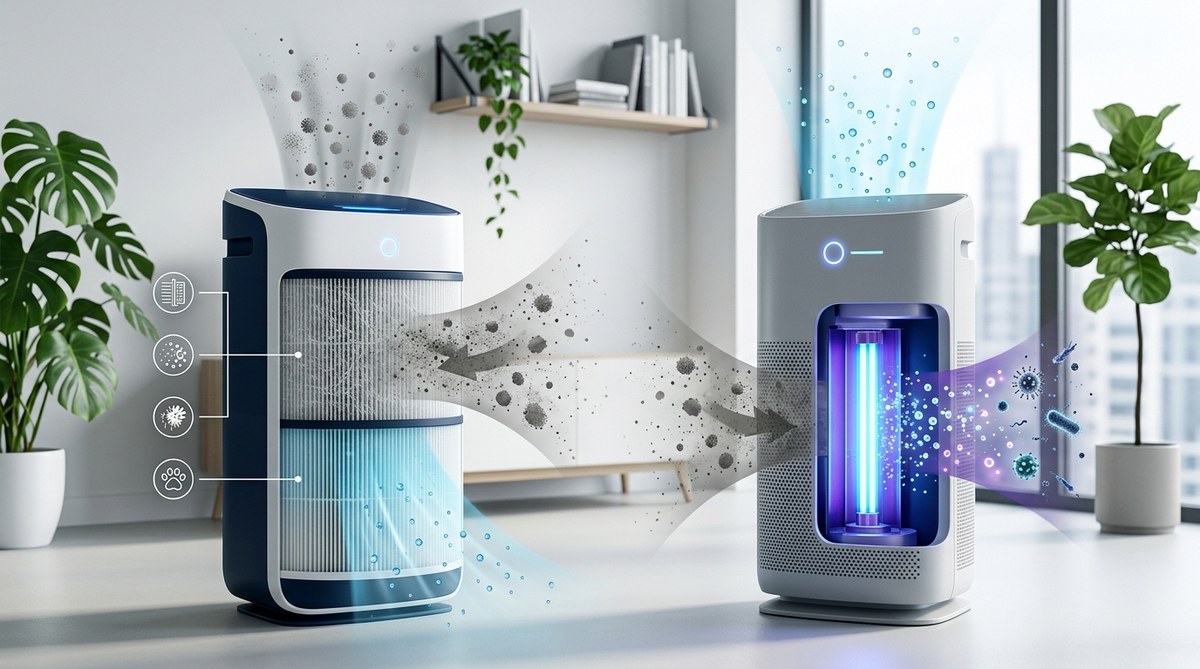
HEPA stands for High-Efficiency Particulate Air. A true HEPA filter is a mat of randomly arranged fibers, usually fiberglass. As air pushes through, particles get trapped in three ways: interception (particles stick to fibers), impaction (larger particles crash into fibers), and diffusion (tiny particles bounce around and get caught). A true HEPA filter captures at least 99.97% of particles that are 0.3 microns in size. That covers pollen, dust mites, mold spores, pet dander, smoke, and even many bacteria.
UV-C air purifiers use ultraviolet light with a wavelength between 200 and 280 nanometers. This type of light can damage the DNA or RNA of microorganisms, which stops them from reproducing. In theory, that means UV-C can reduce viable bacteria, viruses, and mold spores in the air. But there is a catch. UV-C light needs direct exposure for a certain amount of time to be effective. If air moves past the bulb too quickly, microorganisms do not get enough dose to be neutralized.
So right away you can see the difference. HEPA pulls pollutants out of the air physically. UV-C tries to neutralize them with light, but the particles remain in the room unless they are also filtered out.
What Each Technology Does Best (and Where It Falls Short)
To make the comparison clear, here is a side-by-side look at what HEPA and UV-C handle well and where they struggle.
| Air Quality Concern | HEPA Filter Performance | UV-C Light Performance |
|---|---|---|
| Dust and pollen | Exceptional. Traps nearly all particles. | Minimal. UV-C does not capture particles. |
| Pet dander | Excellent. Captures dander and fur. | None. Light has no effect on pet dander. |
| Mold spores | Very good. Traps spores from the air. | Moderate. Can inactivate spores with enough exposure time. |
| Bacteria and viruses | Good. Physically traps them in the filter. | Good in theory. Requires sustained contact time. |
| Smoke and VOCs | Good for smoke particles. No effect on gases. | No effect on smoke or chemicals. |
| Odors | No. HEPA does not remove smells. | No. UV-C does not remove odors. |
| Ozone production | None. HEPA filters produce no ozone. | Some UV-C units can generate ozone, especially older designs. |
Look at that table for a minute. You can see that HEPA covers the vast majority of everyday indoor air problems. UV-C only targets one specific category living microorganisms and even then, real-world results vary.
The Problem with UV Air Purifiers That Nobody Talks About
There is a reason you see more HEPA purifiers in homes than UV units. The main issue is that UV-C light struggles to work in the fast-moving air inside a typical purifier.
Most portable air purifiers move air at a rate of 100 to 300 cubic feet per minute. That air rushes past the UV bulb in a fraction of a second. Studies from multiple research groups show that airborne pathogens need several seconds of continuous UV-C exposure to be inactivated. A quick flash of light as air zooms by does not get the job done.
“For UV-C to be effective against airborne pathogens, the air must be exposed to the light for a sufficient duration. Most consumer-grade UV air purifiers do not provide enough contact time to meaningfully reduce viable microorganisms. A HEPA filter, by contrast, works regardless of airflow speed.” Environmental Protection Agency, Guide to Air Cleaners in the Home
Another concern is ozone. Some UV-C bulbs, particularly those that use a wavelength of 185 nm, produce ozone as a byproduct. Ozone is a lung irritant. The California Air Resources Board actually bans air purifiers that emit measurable amounts of ozone. If you buy a UV-only unit, you need to check that it is certified as ozone-free.
A third issue is maintenance. UV bulbs lose intensity over time. The manufacturer usually recommends replacing the bulb every 12 months. If you forget, the unit becomes little more than a fan moving air around your room.
When UV-C Makes Sense (and When It Doesn’t)
UV-C technology is not worthless. It has legitimate uses in specific settings. But for a typical home, the value is limited.
UV-C works best in these situations:
- HVAC systems with long duct runs. In-duct UV lights have more time to treat air as it moves through the ductwork.
- Upper-room UV fixtures. These are mounted high on walls and treat the air that circulates near the ceiling. Hospitals often use them.
- Combination units. Some purifiers pair UV-C with a HEPA filter. The UV light treats the filter surface to prevent mold or bacteria from growing on the media.
UV-C does not work well in these common home scenarios:
- Portable units with short UV exposure paths
- Rooms with high airflow that reduces contact time
- Spaces where the main concern is dust, pollen, smoke, or pet dander
- Homes where someone has asthma or allergies to particulates
If your main goal is to reduce allergens and breathe easier, UV-C alone will leave you disappointed. You want a filter that physically removes those particles from your air.
How to Choose the Right Air Purifier for Your Home
Here is a straightforward process to decide which technology fits your needs.
-
Identify your primary air quality concern. Is it allergies from pollen and dust? Smoke from wildfires or cooking? Pet dander? Odors? Or are you worried about germs and viruses? Write down your main reason for buying a purifier.
-
Match the technology to the problem. If your list includes dust, pollen, dander, smoke, or mold spores, choose a HEPA filter. If your concern is strictly airborne bacteria or viruses, consider a combination unit that includes both HEPA and UV-C. Do not buy UV-C alone.
-
Check the CADR rating. Clean Air Delivery Rate tells you how much air the unit filters per minute for pollen, dust, and smoke. For a bedroom, aim for a CADR of at least 100 for each pollutant. For larger rooms, go higher.
-
Verify it is a true HEPA filter. Some products say “HEPA-type” or “HEPA-like.” These are marketing terms and do not meet the 99.97% standard. Look for “true HEPA” or “HEPA H13” or higher.
-
Look for energy efficiency and noise levels. A purifier that runs 24/7 should use minimal electricity. Check the decibel rating to make sure it is quiet enough for sleep.
For more guidance on matching a purifier to your specific situation, check out the guide on how to choose an air purifier for asthma and allergy relief. It walks through room size, filter type, and maintenance.
A Simple Way to Get the Best of Both Worlds
You do not have to choose only one technology. Many modern air purifiers combine a true HEPA filter with a UV-C light. The HEPA filter catches the particles. The UV-C light then shines on the filter media to keep mold and bacteria from multiplying on the surface.
This hybrid approach solves the contact time problem. Instead of trying to zap microorganisms as they fly past, the UV light has a steady target the captured particles sitting on the filter. That gives the light plenty of time to work.
When shopping for a combination unit, here is what to look for:
- A true HEPA filter with a high CADR rating
- A UV-C bulb that is enclosed so you never see the light directly
- Certification that the unit produces no harmful ozone
- Easy access to replace both the filter and the UV bulb
Be aware that combination units cost more to maintain. You have to replace the HEPA filter every 6 to 12 months and the UV bulb once a year. Budget for those ongoing costs before you buy.
If you want to see some top-rated models that pair these technologies effectively, take a look at the top air purifiers for allergies and asthma relief in 2026. They focus on units that prioritize filtration while adding UV-C as a secondary benefit.
Common Mistakes People Make When Buying Air Purifiers
People spend good money on air purifiers and then accidentally undermine their own results. Here are the most common errors.
- Buying a UV-only purifier for allergies. This is the biggest mistake. UV does nothing to pollen, dust, or dander. You end up with a machine that runs but does not solve your problem.
- Putting the purifier in a corner. Air needs to circulate freely around the unit. Place it at least 12 inches from walls and furniture.
- Running the unit on low all the time. Low settings are quieter but move less air. Use medium or high during peak allergy times.
- Forgetting to change the filter. A clogged filter stops working. Set a calendar reminder every 6 months.
- Assuming UV-C kills everything instantly. Even in the best conditions, UV-C needs time. It is not a sterilizer in portable home units.
Many of these mistakes come down to misunderstanding how the technology works. That is exactly why reading a detailed comparison like this one helps. For a broader look at things that can go wrong, see the article on why your air purifier isn’t working as well as it should. It covers filter care, placement, and sizing.
Putting Your Decision into Action
At this point you know the key facts. HEPA filters physically remove particles from the air. UV-C light tries to neutralize microorganisms but needs time and direct exposure. For most homes, HEPA is the clear winner. If germs are a specific concern, look for a combination unit that uses UV-C on the filter media rather than on fast-moving air.
Here is a quick summary of recommendations based on your situation.
- You have allergies or asthma. Get a true HEPA purifier with a CADR of at least 100.
- You are worried about germs and viruses. Choose a HEPA purifier with an integrated UV-C light that treats the filter.
- You want to reduce smoke and VOCs. Add an activated carbon filter to a HEPA unit. UV-C will not help.
- You have a tight budget. Stick with HEPA. It is more reliable and costs less to maintain.
- You want the absolute cleanest air possible. Buy a HEPA purifier with a carbon prefilter and a UV-C light for the filter surface.
For a deeper look at how to set up your home for the best air quality, read the tips on how to maximize air purifier effectiveness for a healthier home in 2026. It covers placement, run times, and maintenance schedules.
Why Most Homes Are Better Off with HEPA
If you take only one thing away from this comparison, let it be this. HEPA technology is proven, reliable, and effective against the pollutants that bother people most. UV-C has a narrower job and requires careful conditions to work. The marketing on some UV purifiers makes bold claims, but the science shows that HEPA delivers consistent results.
Think about your own home right now. What is floating in your air? If it is dust from a construction project nearby, pollen from spring bloom, dander from your dog, or smoke from a neighbor’s fireplace, HEPA handles all of it. UV-C does nothing for any of those.
That does not mean UV-C is a gimmick. It has real value in hospitals, labs, and HVAC installations where contact time and controlled conditions exist. But for the living room, bedroom, or home office, prioritize particle filtration.
One Last Thought Before You Buy
Breathe clean air is not complicated when you pick the right tool. A true HEPA air purifier sized correctly for your room will make a noticeable difference within days. You will sneeze less, sleep better, and feel more comfortable. UV-C can add an extra layer of protection, but only if you understand its limits.
Trust the technology that the EPA, the American Lung Association, and allergy specialists have recommended for decades. HEPA filtration is the gold standard for a reason. If you want to add UV-C as a secondary feature, go ahead. Just do not rely on UV alone.
For a complete overview of how to build a healthier indoor environment, read through the top strategies to improve indoor air quality and create a healthier living environment. It covers ventilation, humidity, and purifier selection together.
Your lungs work hard every single day. Give them air that is genuinely clean, not air that has just been waved past a light. Choose HEPA first, consider UV-C second, and enjoy the difference real filtration makes.